
Last updated: May 2026. Pricing, regulations, and entry requirements may change — confirm current details with operators directly. Check travel.state.gov before booking international travel.
In Majuro the luxury signal is not a marble lobby or a sunset bar menu. It is a domestic seat that actually departs, a boat that really shows up, a room with working air-conditioning after an outer-island hop, and enough time in the schedule to absorb delay without panic. The Marshall Islands are not a “resort destination” in the usual American sense. They are a remote Pacific commitment — and for the right traveler, a very good one. Here’s how I’d think about it.
The Marshall Islands at a glance — and why most travelers skip it
The Republic of the Marshall Islands is made up of 29 coral atolls and 5 islands spread across more than 750,000 square miles of ocean, with Majuro as the main entry point for international arrivals. English and Marshallese are official languages, the U.S. dollar is the working currency, and U.S. citizens do not need a tourist visa under the Compact of Free Association framework. That part is unusually easy. Everything after arrival gets harder. That’s the trade.
This is one of those places where “luxury” means access, buffer days, and a willingness to pay for private fixes in a destination that still runs on local pace. If you want a polished five-star island chain with spa inventory and glossy concierge desks, go elsewhere. If you want real atoll geography, WWII wreck history, serious remoteness, and a trip most people around you will never even consider, this is where it starts. For the broader logic behind that kind of trip, my working framework is in the luxury travel 2026 piece.
Mili, Maloelap, Likiep — what each atoll actually offers
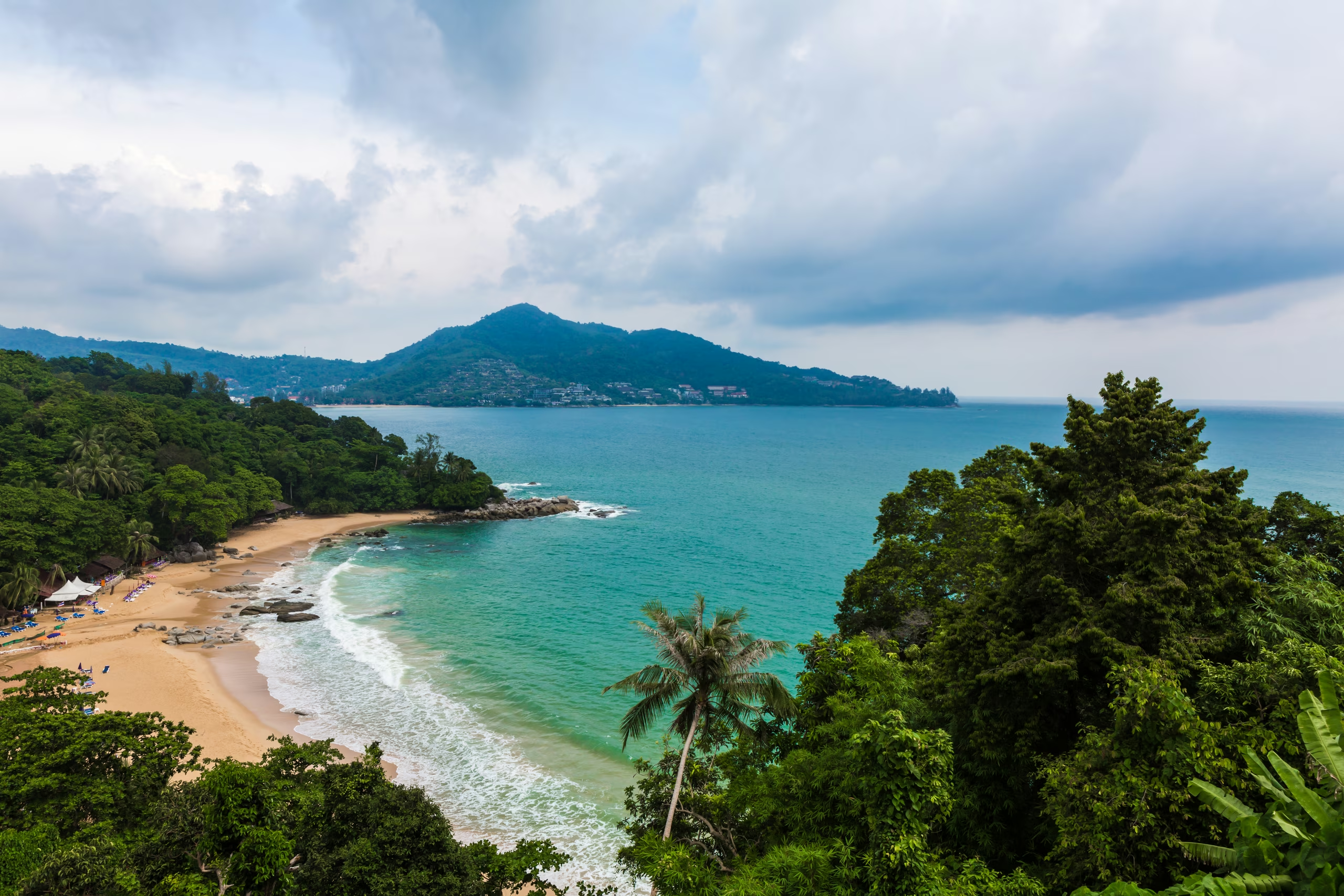
Mili is the easiest of the three to describe because the contrast is so clear: there is outer-island beauty, there is WWII debris in the water, and there is very basic lodging on Wau Island — seven thatched huts, not a resort fantasy. Maloelap is the one divers and war-history people talk about most because it held a major Japanese base during World War II, with shallow wrecks and relics that still shape why visitors come. Likiep has its own appeal, but I would frame it less as the “wreck atoll” and more as the decompression atoll: lagoon time, slower days, snorkeling, fishing and wreck history without the same battlefield emphasis.
If you are building a 10- to 12-day trip, I would not try to touch all three unless you have a fixer on the ground and an appetite for less flights, more waiting, and the possibility that weather rearranges your plan. Two outer atolls plus Majuro is a cleaner shape.
Here is how those atolls fit into a ten-day plan:
- Days 1-2: Arrive in Majuro, sleep, sort cash, confirm onward transport, and do not pretend this is a same-day connection destination.
- Days 3-5: Mili if you want basic atoll lodging and low-key water time, or Maloelap if WWII wrecks are the center of the trip.
- Days 6-8: Second outer atoll, with one empty day built in for weather drift or schedule changes.
- Days 9-10: Back to Majuro for padding, laundry, repacking, and the international departure.
WWII diving the Maloelap wrecks (and why divers come for this specifically)
Maloelap is not famous because it is easy. It is famous because the war is still there under the water in a way that feels startlingly close. User-supplied dive research points to wrecks including the Danver shipwreck, about 29.5 meters long in only 5.1 meters of water, plus another roughly 32-meter wreck with an anti-aircraft gun still part of the draw. If you want Marshall Islands wreck diving that feels specific rather than generic, this is the atoll that justifies the detour.
The diving is the reason people come, the logistics are the price of entry. PADI’s country overview says visibility can exceed 30 meters and water temperatures generally sit around 27°C, which helps explain why the Marshall Islands keep a devoted niche following among divers who do not need polished surface infrastructure to stay interested.
Getting around: Air Marshall Islands and the charter-boat reality
Official tourism guidance is blunt enough: inter-island travel is primarily by domestic flight or boat. Air Marshall Islands is the backbone if you are atoll-hopping on a clock, but schedules are limited and weather sensitivity is real. The U.S. State Department country page is even blunter, describing outer-island air transport as unreliable and boat travel as potentially hazardous in rougher months. Build the trip like a person who expects delay, not like a person who is hoping not to be inconvenienced.
Three things worth booking before you leave home
Your Majuro hotel for both ends of the trip. Your first domestic sector on Air Marshall Islands. And a backup night in Majuro that can accomodate weather, maintenance and load changes. No drama, ideally.
Where to sleep on an atoll with 1,000 residents
This is where American luxury travelers need to reset expectations fast. On outer atolls, your not booking a design hotel with a chef’s tasting menu. You are booking what exists. Official Marshall Islands tourism language talks about guesthouses, boutique hotels, and family-run lodges, but the inventory is thin outside Majuro and a few better-known islands. By outer-island standards basic, clean, and functional is already a win.
Mili’s Wau Island is useful as a reality check: thatched huts, fans, showers, small scale. That is not a flaw. It is the product. The real luxury add-on here is not thread count; it is having your transfers handled, your meals thought through, and enough structure that the trip feels adventurous without slipping into chaos.
Bikini, climate change, and the ethics of visiting at-risk islands
Bikini is not a casual add-on and not a beach-day concept. UNESCO’s listing is for the Bikini Atoll Nuclear Test Site, and the official significance is inseparable from the nuclear tests, the displacement that followed, and the damage that occured to land and people. Dive operators market Bikini for elite wreck diving between roughly May and October, typically for advanced technical divers, and some operator literature cites DOE and Lawrence Livermore work to argue that radiation dose from swimming and diving is essentially negligible. That may matter for a diver’s personal decision. It does not cancel the history, displacement and radiation legacy.
The other ethical layer is climate. A recent World Bank-backed visualization says sea-level rise could endanger 40% of existing buildings in Majuro. So yes, you can visit. But you should arrive understanding that this is not a weightless tropical fantasy. It is a low-lying nation living inside the future tense of climate risk.
Practical: U.S. passport, dollar, internet, what to pack
Broadly speaking this is one of the easier Pacific countries for Americans on entry and one of the harder ones on logistics. U.S. citizens do not need a visa to enter the Marshall Islands, the country uses the U.S. dollar, and the current U.S. advisory remains Level 1: Exercise Normal Precautions. Cash matters, cards don’t reliably save you outside Majuro and Kwajalein.
Pack light long sleeves, reef-safe sun protection, conservative clothing for villages, and enough medication to cover delay. The State Department says medical evacuation can frequently exceed $100,000, and local tourism pages note there is one hospital in Majuro. Water, too, is not something I would approach casually on outer islands. Filter, boil, or use bottled sources when in doubt. If remote-island travel is part of your long-game taste, you’d probably also like the logic behind the Amazon eco-luxury guide.
Five Questions People Actually Ask
Do I need a visa as an American?
No. The U.S. State Department country page says U.S. citizens do not need a visa to enter the Marshall Islands under the Compact of Free Association arrangement.
Is this actually a luxury trip?
Yes, but not in the standard resort sense. The luxury here is access, privacy, staff help, and not having to improvise every transport decision in a place where almost everything is thinly provisioned. Quietly intense.
Can I do Bikini and the outer atolls in one trip?
Only if Bikini is the central reason you are coming and you are already a qualified advanced diver. For most travelers, Bikini plus one or two outer atolls is enough.
Is Maloelap worth it if I don’t dive?
Possibly, but the strongest argument for Maloelap is still underwater war history. If you dive or snorkel, it makes much more sense; if you don’t, Mili or Likiep may feel more natural.
Should I worry about safety or climate ethics?
Normal precautions are fine according to the current U.S. advisory, but ethics matter here more than in a lot of beach destinations. Go lightly, spend locally where you can, and understand that climate risk is not abstract in the Marshall Islands.
Where to go next?
- In the Heart of the Amazon — another remote-water-and-logistics trip where the real luxury is access, guides, and getting the hard parts right.
- Luxury Travel 2026 — useful if you want the bigger framework for why difficult, low-inventory trips now sit at the top of the market.
- Grand Canyon Utah — a good next read if your taste runs toward raw landscapes and long-distance planning, but you want a lower-friction U.S. version.