
Last updated: May 2026. Prices, opening hours, and entry requirements shift with seasons and policy changes — confirm directly with operators or official sources before booking. U.S. travelers should check travel.state.gov for current entry requirements.
In July the stone in Athens throws heat back at your ankles, ferry decks smell like salt and diesel, and dinner in the Cyclades rarely starts before the light softens. Greece looks easy from far away — blue shutters, white walls, a boat, done. The real version is better, but only if you edit hard. This is not the country for trying to “see everything.” Here’s how I’d actually do it.
Greece is bigger than the fantasy version
For American travelers, the first mistake is treating Greece like a single neat vacation shape. It isn’t. In 2025 the country pulled in about 37.98 million international visitors and more than €22 billion in tourism revenue, which tells you two things fast: demand is huge, and the obvious places feel it first. Greece can handle luxury beautifully, but its not a single trip. It’s a set of different moods that happen to share a language, a sea, and a talent for making lunch turn into sunset.
The second mistake is route greed. You do not need Athens, Santorini and Mykonos and Crete and Naxos and Rhodes in ten days. You need less islands, more time per stop, and a route that doesn’t make every other morning feel like an airport transfer. That helps.
Athens first, always
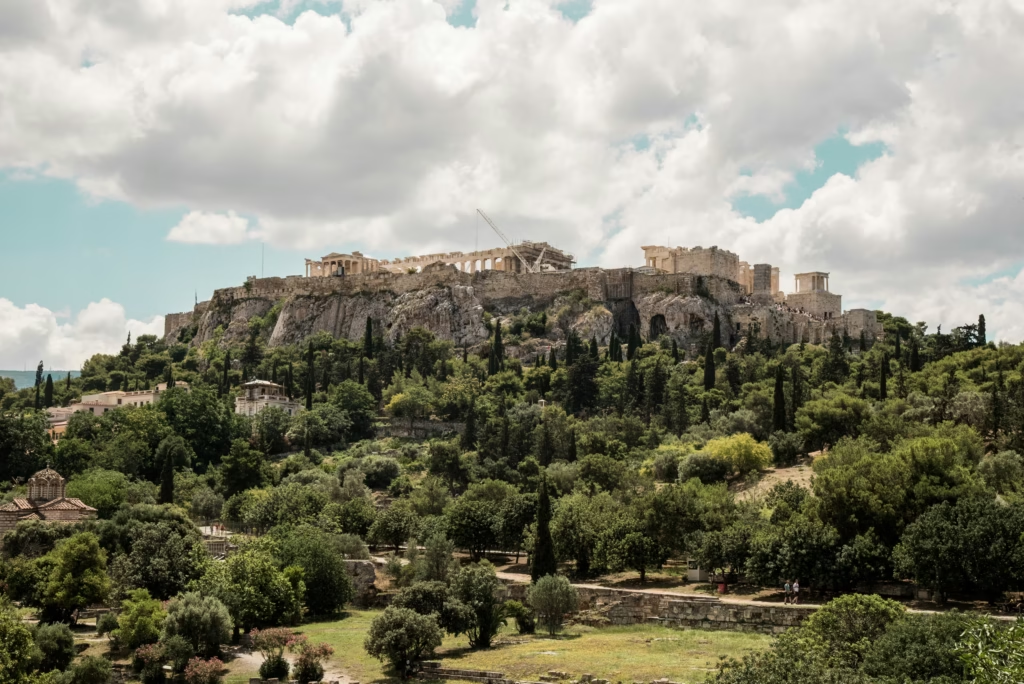
If you only have a week Athens still deserves at least two nights, and three is better. Not because the city is your beach break, but because its where the trip gets its bearings. Do the Acropolis early, book the Acropolis Museum afterward, and use the rest of your time for the version of Athens that actually works: rooftop drinks, long lunches, and walking between Plaka, Kolonaki and Syntagma instead of treating the capital like a layover.
Athens can look chaotic on paper, it travels surprisingly smoothly once you’re in the center. The luxury question here is less about hiding from the city and more about choosing how close you want to be to the friction. I still think the classic move is one polished central hotel, one early Acropolis slot, and one rooftop dinner where the hill stays in view while the city cools down.
If you want a land-based extension, Delphi is the cleanest one from Athens. It’s about 180 km and roughly 2.5 hours by car each way, which makes it doable as a long day if archaeology is your thing and miserable if you’re forcing it because the guidebook told you to.
Santorini and Mykonos are not interchangeable
Santorini is for views, privacy, and the kind of hotel stays where the room is half the reason you came. Mykonos is for energy, beach clubs, and people who don’t mind paying a premium for logistics that feel slicker than most Greek-island logistics ever do. By September both islands are still warm, but the crowds are less punishing than July and August. That matters more than people admit.
My advice is blunt. Do not book both unless you have at least ten days total and you know why each one belongs. Santorini is where your paying for position — caldera line, sunset line, transfer ease, terrace footage. A lot. Mykonos is where you pay for access: the right beach scene, the right dinner reservation, and the fact that glamorous nonsense can be fun when it’s handled well.
Also, remember the mechanics. Athens to Santorini by air is under an hour. The ferry from Piraeus can run roughly 4 hours 50 minutes on a faster service or much longer on slower vessels. That is not a small difference when you’re designing a high-end trip.
Crete, Naxos, and Rhodes are where the trip starts breathing
Crete is the island I’d use to calm the whole itinerary down. It is big enough to accomodate different versions of luxury — beach resorts, serious food, archaeological stops, longer drives, and enough room that you don’t feel pinned into one overphotographed strip. If you want one island that can carry four or five nights without getting repetitive, Crete is the adult answer.
Naxos is the corrective to a postcard-only route. It has space. Better beaches than first-timers expect, better value than Santorini and Mykonos once summer has fully occured, and the kind of villages, food and beaches that feel lived-in rather than staged for two-hour cruise traffic. If I were sending friends on a honeymoon who wanted one Cycladic island without the full-performance pressure, Naxos would be in the conversation fast.
Rhodes is the wild card that works especially well for travelers who want a bigger island with a stronger built-history layer. The Old Town is not subtle, and that’s part of why it works. You can walk from the port straight into the walls, which gives the island an unusually easy arrival compared with more transfer-heavy Greek stops. The official Rhodes tourism site is actually useful for this one because events, site access, and local practicalities change more than older blog posts admit.
Where luxury is worth the money
Luxury in Greece is rarely about chandeliers. More often its where you buy back time: a hotel with a real view, a transfer that keeps you off a hot dock with suitcases, a suite that lets you stay put for half a day without feeling trapped, or a boat day that turns a crowded island into your background instead of your problem.
In Athens, pay for location. In Santorini, pay for the terrace and the room category. In Mykonos, pay for service and transport sanity. In Crete, pay for the property itself because you’ll actually use it. In Naxos and Rhodes, the sweet spot can be slightly lower on paper while still feeling genuinely high-end in real life.
Three things worth booking before you arrive
Your first two hotels. If you are going in peak season, waiting for “flexibility” usually just means paying more for a worse room.
Your key museum or archaeology slots. Athens, Rhodes and other major sites are easier now if you commit early.
Your inter-island transport. Flights are often worth more than the romance of yet another ferry.
How I’d split 7, 10, or 14 days
The elegant version of Greece is usually the simpler one. Ferry timings look easy online, they eat half-days in real life. That’s why I’d build around two or three bases, not five.
- 7 days: Athens (3 nights) + one island only. Pick Santorini for hotel-driven romance, Crete for range, or Naxos for a calmer Cycladic stay.
- 10 days: Athens (3) + Santorini or Mykonos (3) + Naxos or Crete (4). This gives you one glossy stop and one exhale stop.
- 14 days: Athens (3) + one Cycladic island (3) + Crete (4) + Rhodes (4), or swap Rhodes for Naxos if you want less moving and more beach time.
What I would skip: Athens + Mykonos + Santorini + Crete + Rhodes in under two weeks. Too much repacking, too many transfers, not enough actual living. Less moving.
Before you book anything, run your route once against the official tourism site, the Crete regional portal, and official museum or site pages. Greece changes hours, transport rhythms, and ticketing systems more often than old SEO sludge suggests.
When to go, and what to skip
For most luxury travelers, the sweet spots are May to mid-June and late August through September. That’s the balance of weather, swimming, and price. July and August are perfectly viable, but they are hotter, louder, pricier, and more logistically annoying. If you come then, spend accordingly and don’t pretend you’re getting a bargain.
Skip Greece in one week if your fantasy requires six islands. Skip midday Acropolis climbs in July. Skip same-day ferry chains. And skip the assumption that only Santorini and Mykonos count. They do count. They’re just not the whole country.
Five Questions People Actually Ask
Can you do a real Greece luxury trip in 7 days? Yes, but only if you keep it to Athens plus one island. Two islands can work, though the trip gets thinner fast.
Santorini or Mykonos? Santorini if you care more about the hotel and the view. Mykonos if you care more about beach clubs, nightlife and social momentum.
Is Naxos worth adding to a high-end trip? Absolutely. Especially if you want sea time and village time without paying Santorini rates every single day.
Do Americans need a visa for Greece in 2026? No, not for short tourist visits. Greece is still visa-free for U.S. citizens up to 90 days in any 180-day period, though the EU’s border systems have changed and you should recheck rules before departure.
What’s the best first Greece route? Athens, one glossy island, one bigger slower island. That’s the formula I trust most for first-timers with 10 to 14 days.
Where to go next?
- Athens, Greece luxury guide — for the city-specific deep dive.
- Cultural travel framework — for the three-legs rule applied to Greece.
- Rome, Italy practical luxury guide — for a Mediterranean pair.