
Last updated: May 2026. Pricing, regulations, and entry requirements may change — confirm current details with operators directly. Check travel.state.gov before booking international travel.
The Iceland that stays with people is rarely the brochure opener. It is wet moss near a lava field, metallic air coming off glacier ice, and a silence so complete it makes your jacket sound loud. For American travelers in 2026 the better luxury trip is not Blue Lagoon first and Golden Circle second. It is slower, rougher around the edges, and much smarter about season. Here’s how I’d do it.
What raw Iceland actually means in 2026
Raw Iceland in 2026 does not mean reckless Iceland. That matters most on the Reykjanes Peninsula, where official eruption guidance still treats the area as dynamic: the broader peninsula is open, but zones around Grindavík and Svartsengi can change quickly. So yes, go to Reykjanes for geology. No, don’t build the whole trip around a lava fantasy you saw online.
Luxury here is not polish. It is good timing, a driver who knows when to turn around, and a hotel that makes bad weather feel like part of the day instead of a ruined one. Different thing.
The Westfjords — and why most luxury travelers should add 3 days
If you want Iceland with less traffic and more consequence, add the Westfjords. The region stretches across roughly 22,000 square kilometers and feels cut loose from the rest of the country before you even start driving. Distances look manageable, they are not.
Hornstrandir makes the case fast. It is reached only by boat, and it remains the only place in Iceland where Arctic foxes are fully protected from hunting. That changes the mood immediately. You are stepping into a place built around weather, cliffs and animal life rather than convenience.
Then there is Látrabjarg, one of Europe’s major bird cliffs and still one of the best arguments for giving Iceland actual time. The reserve rules matter here: no casual drone flying, no overnighting, no acting like the fence is optional. Respect the barriers. Don’t imitate the tourist leaning over the edge for a better phone shot, thats how people start making bad decisions.
Highlands access: F-roads, season windows, and the 4WD reality
Landmannalaugar and Þórsmörk are not default summer stops. They are conditional stops, and the condition is its road.
The 2026 highland forecasts published by Camper Iceland’s F-road opening tracker still had all F-roads closed in late March, with Landmannalaugar access via F208 projected roughly around June 10 to 20 if the melt behaved. Forecast, not guarantee. More importantly, driving the highlands before official opening dates is illegal.
If your trip depends on the highlands go in July or August. June can work, but only if your willing to treat Landmannalaugar or Þórsmörk as a maybe. Early September is still good, but the season starts narrowing and the margin for improvising gets thinner.
Three things worth doing first
Book the highlands day before the hotel near it. Build in one weather buffer day. Decide early whether this is a summer highlands trip or a winter ice-cave trip, because one itinerary cannot elegantly do both.
Glacier hikes, Diamond Beach, and the winter-only ice-cave rule
For travelers who want direct contact with ice without turning the week into a survival exercise, glacier hiking is the sweet spot. Sólheimajökull is the practical entry point, and standard three-hour guided hikes in 2026 are still landing around $90 to $135 per adult. For Iceland, that is fair pricing for something that actually changes your sense of scale.
If you can push farther east then Vatnajökull gives you the stronger payoff. The official Jökulsárlón regional guide still describes the lagoon spilling toward the Atlantic and leaving ice on the black sand at Diamond Beach. It works, it always does. Seals in the water. Ice rubbing against itself. Wind with teeth.
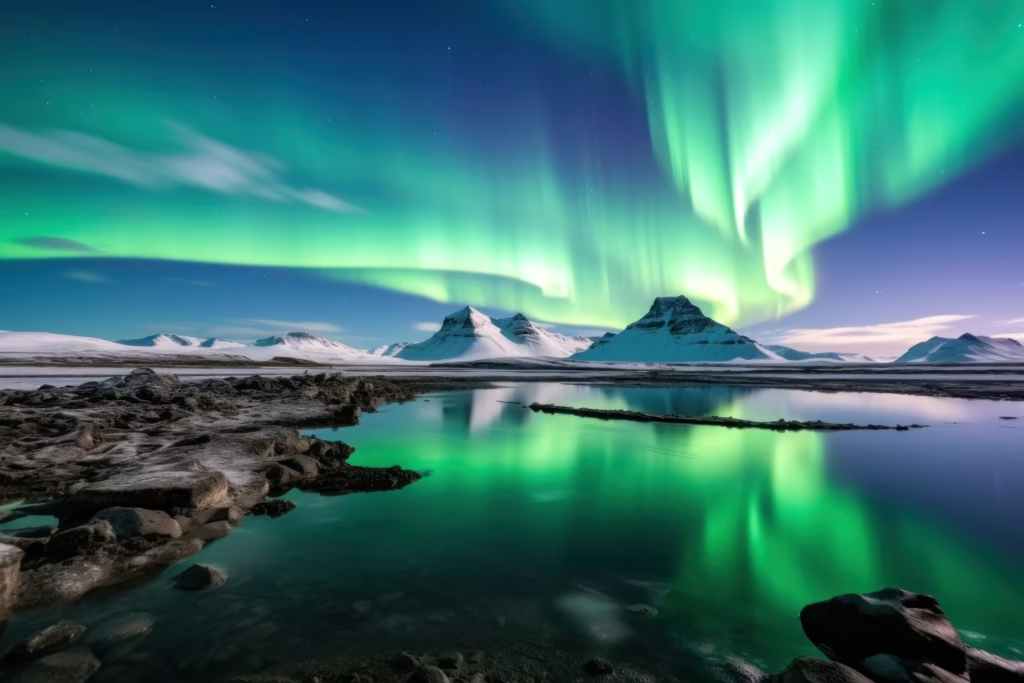
Ice caves are where people get dreamy and sloppy. They are not a year-round add-on. Natural cave departures in southeast Iceland are generally a November-to-March product, with the most reliable window running in the winter core. If your actual trip is summer, stop trying to force a winter product into it. If winter sky is your real engine instead, start with the companion piece on Iceland northern lights camping.
Where to stay outside Reykjavík — what luxury should mean here
My strongest opinion in Iceland is this: do not sleep in Reykjavík every night on an 8-to-12-day wilderness trip. That is not luxury. That is commuting in expensive outerwear.
Luxury outside the capital should mean proximity, weather resilience and guide quality. In the Westfjords, that may mean a small waterside property and a boat departure that leaves from a nearby harbor instead of eating half the day in transfers. In the south it means a hotel positioned for glacier departures or for an early start toward Jökulsárlón. In highland-adjacent zones, it means a warm base that can accomodate route changes without drama.
If you want the fully tailored version, private Iceland programs in 2026 easily run into five figures for couples or small groups. What you are actually buying is access, timing, vehicles and people who know the land. It sounds extreme, it usually buys back time.
Driving Iceland in 2026: rental traps, weather, the Ring Road choice
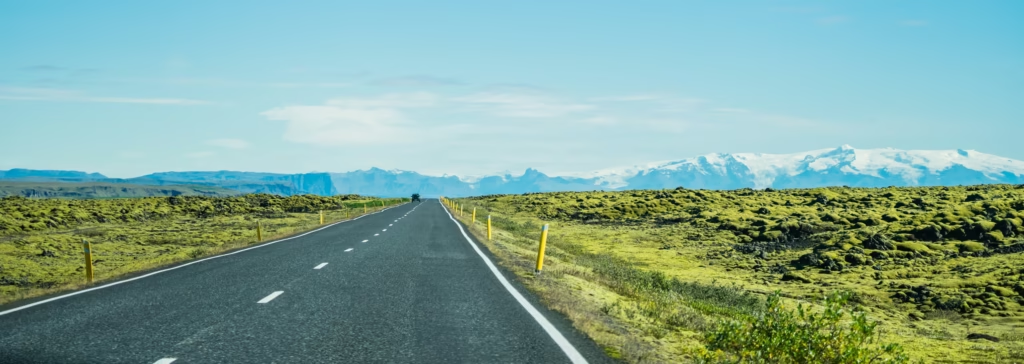
If your goal is wilderness don’t do the full Ring Road in eight days just because that’s what the internet says first. You’ll turn the trip into a windshield exercise and call it freedom. Bad trade.
- Day 1: Reykjanes on arrival, or Reykjavík if your flight lands too late.
- Days 2 to 4: Westfjords.
- Days 5 to 6: south coast with Sólheimajökull or Þórsmörk access.
- Days 7 to 8: Jökulsárlón and Diamond Beach.
- Days 9 to 10: return west with one buffer day for weather.
That shape leaves room for the thing Iceland always does to people: it changes the day. A road closes, a guide shifts the start time, fog rolls in and a boat departure moves. The best luxury itineraries don’t fight that, they plan for it.
Five Questions People Actually Ask
Do I need a 4WD for this trip?
For the highlands, yes. For the Westfjords, I’d still choose one if budget allows because it lowers stress on gravel and rougher secondary roads.
Is Reykjanes safe after the eruptions?
Broadly yes but only if you treat it as a monitored volcanic zone, not a casual roadside stop. Restricted areas shift, and official updates matter more than old blog posts.
Should I skip the Blue Lagoon?
Not necessarily. Just make it the soft landing or the last-night decompression, not the headline of a wilderness itinerary.
Are ice caves worth planning the whole trip around?
Only between November and March. Outside that window, your building the wrong Iceland.
How many nights should I give the Westfjords?
Three minimum. Two nights is possible, but it turns the region into a checklist instead of a place and gives you less transfers than you actually need.
Where to go next?
- Iceland Northern Lights Camping — the winter counterpart to this piece, if your trip is really about dark skies and snow season.
- Luxury Travel 2026 — the broader framework behind how I pick pace, hotel weight and what is actually worth splurging on.
- Grand Canyon Utah — another nature-first trip where the real question is not what to see, but how to structure the days.