Last updated: May 2026. Pricing, regulations, and entry requirements may change — confirm current details with operators directly. Check travel.state.gov before booking international travel.
A woman shaping black clay in Oaxaca does not need your admiration nearly as much as she needs your full attention, your patience, and payment that respects her time. That’s the sentence I wish more “cultural travel experiences” articles started with. The phrase gets sprayed across brochures so freely now that it can mean anything from a resort dance show to a one-hour chef demo. its usually code for “we found something photogenic.” Usually not. Here’s what cultural immersion actually looks like when the traveler is serious and the host isn’t turned into scenery.
What “cultural” tourism actually means in 2026 (and what it doesn’t)
Honestly the easiest way to define cultural immersion is by subtraction. It is not a VIP seat at a folklore performance sold as insight. It is not a guide explaining “how locals live” while you move from air-conditioned car to air-conditioned table. And it is definitely not the old white-savior script where a traveler narrates a place as if they arrived to preserve it. What counts now is slower and much less flattering: time, money and attention given to a practice that existed before you got there and will continue without your approval.
That usually means craft, food, routine, repetition. You touch the clay, stain your shirt with cumin, sit through translation gaps, and realize after forty minutes that culture is often boring before it is interesting. Good culture work has dead time, and that dead time matters. If you leave knowing more about how something is made, who gets paid, what is off-limits, and why your presence was structured a certain way, the experience probably did its job.
It also helps to say what the trip is not. A workshop is not a friendship. A hosted dinner is not family membership. A brief village visit is not belonging. That doesn’t make those experiences fake, it just keeps them in proportion. I use the same filter in my broader luxury-travel framework for 2026: ask less “Did I get access?” and more “What did I actually learn, and who controlled the terms?”
Workshops that earn the time — pottery, cooking, weaving
In Oaxaca the strongest luxury version of a workshop is usually not the cheapest one, but the one with enough time built around it to make embarrassment possible. A private pottery-and-alebrijes day currently listed on Expedia’s Oaxaca workshop page runs about six hours and around $1,487 per adult, with transport and entrance fees folded in. Expensive, yes. Also clarifying. You are not paying for “authenticity” there. You are paying for private logistics, access, and the chance to spend real time in a studio without losing half the day to navigation.
In Marrakech the equation shifts. A class at Royal Mansour’s cooking workshops is hotel-shaped from the first minute: two hours, Saturday through Thursday, 10 a.m. to noon, up to six guests. That sounds polished because it is polished. But polished does not automatically mean empty. A good palace cooking class can teach sequencing, spice handling, kitchen vocabulary, and the social logic of a meal. It just won’t tell you much about domestic labor unless the instructor decides to go there. I’d book it for technique and context, not for the fantasy that I’d suddenly understand Moroccan home life.
In Cusco you get something many luxury travelers say they want but rarely give enough hours to deserve: skill humility. The Center for Traditional Textiles of Cusco offers 3.5-hour weaving workshops for $60, full-day at $80, then longer two- and three-day versions. The full-day is the sweet spot. The short version teaches respect. The longer versions teach what respect costs in time. Backstrap weaving is hard on the body, hard on the ego, and excellent for stripping away the fake confidence that rich travelers bring to “learning from artisans.”
My bias is simple: any cultural activity shorter than ninety minutes should be called a demonstration, not immersion.
Homestays — the romanticization problem, and when they work
In practice luxury travelers often say “homestay” when they mean “I want emotional closeness with professional hygiene and an easy exit.” That’s understandable. It is also not what most homestays are. A real stay inside someone’s household can mean thin walls, odd meal times, roosters, barking dogs, kids asking questions when your tired, and bathroom rhythms that do not care how much you paid for the international flight. It can be generous and awkward in the same hour.
That is why I’m suspicious of the homestay as aspiration branding. The best ones are not sold as purity. They are sold as specific arrangements with rules. Who speaks what language. Who eats when. Whether photographs are allowed. Whether you are expected to participate or mostly observe. Without that clarity the guest starts improvising, the host starts over-performing, and the whole thing slides into a bad theater of gratitude.
For luxury travelers, I think shorter is often smarter. Two or three nights can do more than a week if those less nights are bracketed by hotel stays before and after. That gives everyone somewhere to recover, compare notes, and put the experience in context. It also keeps the host family from becoming your full-time cultural concierge, which is rarely fair even when they are very kind.
The test I use is blunt: would this stay still make sense if nobody posted about it. If the answer is no, I’d skip it.
The language question — three tools, two phrases, one rule
Before you go do not attempt fluency theater. Aim for function. I still like Duolingo’s trip-focused language advice because it pushes people toward realistic goals: airport, hotel, restaurant, directions, greetings. The three tools I’d actually pack are simple: a translation app like Duolingo to drill basics, an offline translator (offline Google Translate) for the moments you have no signal, and a paper phrase book as the backup that never runs out of battery. Together that’s what most good travelers actually use. Not because apps are romantic. Because they lower the amount of cluelessness you export into other people’s day.
The two phrases I care about most are embarrassingly basic: “I’m learning your language” and “Could you say that more slowly?” Those do more than clever slang ever will. They lower tension. They make it easier for someone to correct you without having to accomodate your performance. A small thing.
And here is the one rule: language prep is for respect, not applause. If the story of the meal becomes how brave you were for ordering in Spanish, French or Arabic, you have made yourself the subject again. That is the wrong subject. The language is there to open a door, not to prove your character.
Also, use pronunciation practice at home. Quietly. With headphones. There is no medal for trying to sound local on the first day, and its job is not to flatter you anyway.
Indigenous tourism — the ethics, and the operators who do it right
If your first thought when visiting an Indigenous community is “I want to help preserve this culture,” pause there. That sentence sounds generous and lands badly. People are not museum collections, and they are not waiting for tourists to validate their continuity. The traveler’s job is narrower: show up prepared, pay fairly, follow the photo rules, accept the parts that are not for you, and leave without narrating the place as a spiritual correction to your life back home.
That is why IEREK’s piece on community-led Indigenous tourism is useful. It points to the right questions rather than the right feelings. Who designed the route. Who gets the deposit. Who says no to filming. Who explains etiquette. If an operator cannot answer those things clearly, or if the answer is vague talk about empowerment without specifics, move on.
I also distrust any itinerary copy that leans on the words “untouched,” “ancient,” or “real people.” Those terms usually mean the operator wants to freeze someone else in time so the guest can feel moved. Not enough.
Good Indigenous tourism does not flatter the traveler. It gives the community editorial control. Sometimes that means less access than you wanted. Good. That limit is often the most honest part of the experience.
Performance vs lived — and how I’d structure a culturally immersive week
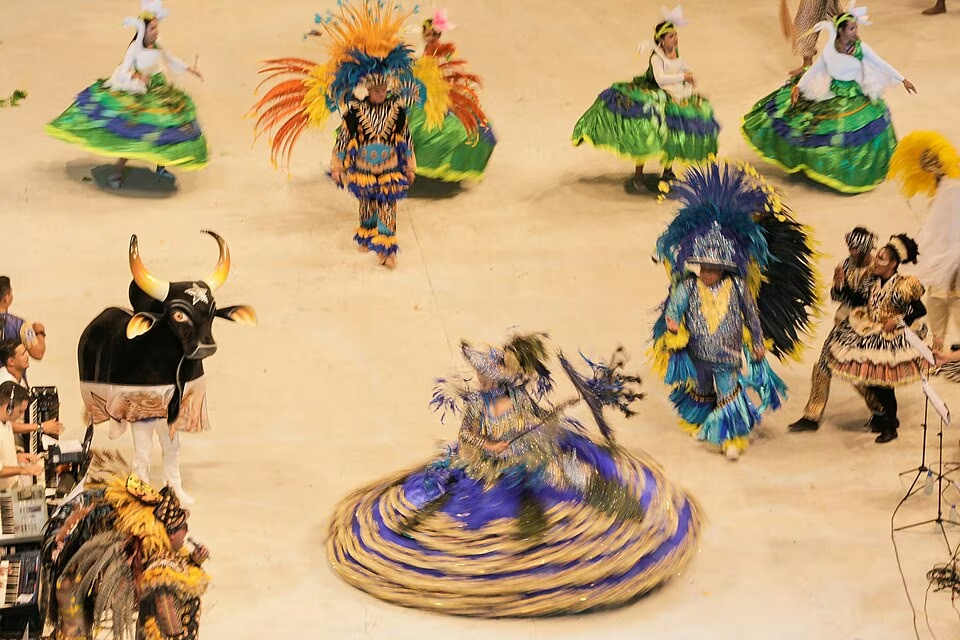
Not all performance is fake. A staged ceremony, a music set, or a dance presentation can be beautifully taught and historically grounded. What makes it different from lived experience is purpose. Performance is built for an audience. Lived experience continues whether or not the audience arrived. One isn’t morally better by default. They are just not the same product.
You can usually tell the difference fast. Performance starts on time, fits neatly before dinner, and ends at the gift table. Lived experience has waiting, repetition, half-finished conversations, and moments where nothing instagrammable is happening. That “nothing” is often where understanding begins.
Three things worth doing first
First, choose one anchor workshop before you buy the flight. Second, leave a buffer day after it. Third, end with one high-comfort hotel night so the trip has somewhere quiet to land. Those three decisions do more for immersion than piling on five “meaningful” activities back to back.
When I design a week like this, I center the trip on one craft, meal and conversation, then I build outward:
- Day 1: arrive and do almost nothing except a neighborhood walk and one serious dinner.
- Day 2: hire a guide for orientation — markets, etiquette, transit logic, and the local version of “what not to do.”
- Day 3: do the workshop. No museum overload afterward.
- Day 4: revisit the workshop neighborhood, shop only if you now understand what you’re buying, and rest.
- Day 5: add a hosted meal, studio visit, or carefully vetted community encounter.
- Day 6: leave blank space for digestion — literal and intellectual.
- Day 7: one final meal or craft purchase, then get out before the trip starts performing for itself.
This is the part brochure writers hate: a culturally immersive week should feel a little underplanned on paper. If every hour is filled, you have probably built a consumption schedule, not a learning one. The best conversations happen because something slipped, someone invited you to stay longer, or a misunderstanding occured and then got explained.
Luxury fits into this just fine. It shows up in pacing, privacy, translation support, thoughtful hotels, and the ability to pay people properly. It should not show up as insulation from discomfort. If it does, you bought distance and called it depth.
Questions People Actually Ask
Is one workshop enough to count as cultural immersion?
For most people yes — if the workshop is long enough, taught by someone with real ownership of the craft, and followed by time to process it. One serious half-day can teach more than four decorative stops.
Are homestays worth it for luxury travelers?
If you need full control over sleep, privacy, and bathroom setup, maybe not. The strongest version for high-end travelers is usually a short, clearly structured stay folded into a hotel-based trip.
Do I need to speak the local language to do this well?
No. You need basics, humility, and a willingness to sound imperfect. A few phrases plus a good guide will take you farther than fake fluency.
Can a luxury hotel cooking class still be meaningful?
Absolutely, if you book it for technique and context rather than transformation. A polished class can still teach a lot, it just shouldn’t be sold to you as daily life.
How do I know if an Indigenous-tourism product is ethical?
Ideally you can answer four questions before you pay: who designed it, who gets paid first, what the photo rules are, and what parts are closed to visitors. If the answers sound fuzzy, keep looking.
Should I bring gifts to a host family or artisan workshop?
Not by default. Ask the operator first. Cash payment, fair purchasing, and showing up on time are usually more useful than surprise presents chosen to make you feel generous.
What’s the cleanest sign that an experience is too performative?
If every emotional beat is pre-arranged, every photo moment is obvious, and the guide, host and artisan all seem to be reading from the same polished script, you’re probably buying a tourism product first and a cultural one second.
Where to go next?
- Luxury Travel 2026 — the broader Yoya framework for choosing high-end trips that feel substantial instead of expensive-for-the-sake-of-it.
- Brazil Luxury Travel Pillar 2026 — useful if you want to test this immersion standard against a country where ecology, music, food and ritual all collide.
- In the Heart of the Amazon — a good next read on how to handle access, ethics, and comfort when the setting is ecological rather than urban.