
Last updated: May 2026. Pricing, regulations, and entry requirements may change — confirm current details with operators directly. Check travel.state.gov before booking international travel.
After enough nights in very good hotels the thing you start craving is not worse sleep. It is exposure. The sound of a bus station at 6:20 a.m., the quick friendship over a shared outlet, the weird efficiency of living out of one pack for three weeks instead of spreading into a suite by habit. Backpacking for a luxury traveler only makes sense when it buys something real. More time, more movement, more contact. its not rebellion. It is a tool. Three weeks changes the math.
When backpacking is the right call even if you can afford better
On a short trip I would almost never choose backpacking over a good hotel. Two to five nights in Rome, Tokyo, or Paris? No. Pay for sleep, pay for location, pay for the shower pressure. But around the two-and-a-half to three-week mark, something shifts. The constant unpacking starts to feel ridiculous. The daily hotel spend starts buying you the same thing over and over — sleep, privacy and control — when what you may actually need is range. That is when backpacking starts to earn its place.
The real case for it is not “cheap travel.” It is long travel. It is the ability to stay out longer without turning every night into a small financial decision. It is also certain regions where the infrastructure already assumes movement: Thailand, Indonesia, Mexico, Portugal, parts of the Balkans. You can get more days, more side trips, less transfers that feel precious. A useful correction.
And yes, the people matter. I do not mean the overworked cliché about “the friends you make along the way.” I mean actual information flow: which ferry got cancelled, which ATM stopped working, which night market is worth your time, which bus is fine and which one is a bad idea after dark. Hostel culture still delivers that better than most boutique hotels do. For a traveler who usually books high-end, that kind of real-time ground intel can be more useful than a welcome drink. hostel culture has changed, the old stereotype lingers. Chains like Generator now openly sell the mixed model: dorms and private rooms under the same roof, which is exactly why backpacking has become legible for people who would never book an eight-bed room on purpose.
In Southeast Asia especially the backpacking format still works because the movement itself is part of the trip. You are not buying a new identity. You are buying time. That matters more than most luxury marketing will admit, and it lines up with the way I framed travel value in our luxury travel 2026 framework: the expensive thing is not always the better thing, sometimes it just protects you from contact.
The actual gear: what earns its pack space
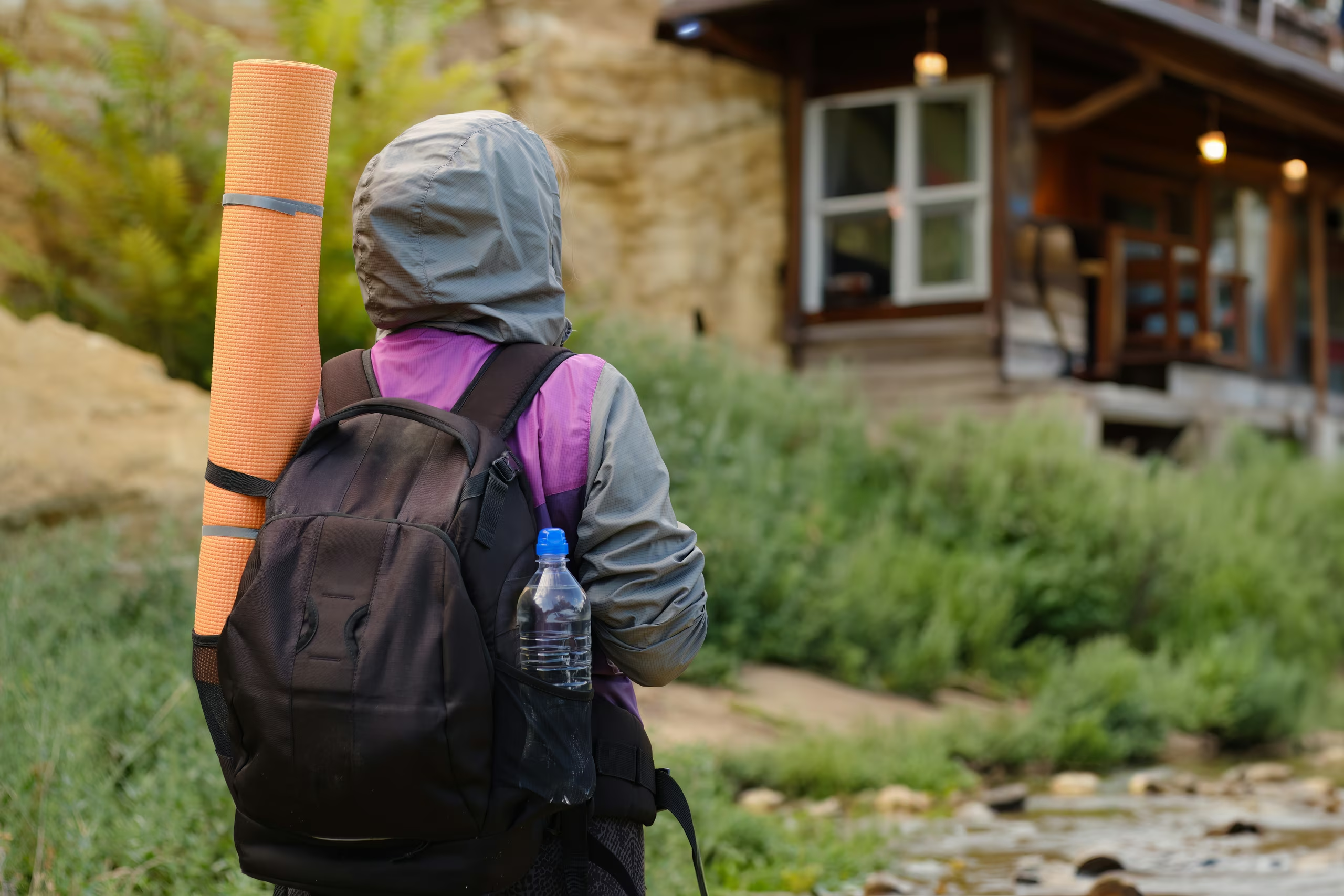
For a first backpacking trip after years of nicer hotels, do not overcorrect into expedition gear. The best contrast in the current market is still Osprey’s Farpoint versus Aether. Nordstrom’s current listing puts the Osprey Farpoint 55 at $220, while retailer listings place the Aether 65 around $320 and frame it as a heavier-load, more technical backpacking pack. That price gap tells the story. The Farpoint is a travel backpack. The Aether is for people who genuinely need to carry more weight for longer, or need a pack that can accomodate real trekking loads. its the better buy for city-to-beach-to-bus travel.
Aether is excellent, it is just the wrong first answer for most luxury-curious backpackers. If you are not trekking with a sleeping system, cooking gear, or serious outdoor kit, 65 liters is usually too much bag and too much invitation to overpack. The bag becomes the trip. Bad sign.
Three things worth buying first
The first is the pack: Farpoint-class, not expedition-class. The second is a merino layer system. The third is a small admin pouch that keeps your passport, cards, meds, charging kit and earplugs in one place so you stop tearing through your whole life at every border desk. Not romance. Friction.
- 2 merino T-shirts
- 1 merino long sleeve
- 1 thin fleece or compact insulated layer
- 1 rain shell
- 2 pairs quick-dry pants or trousers
- 5 pairs socks, 5 underwear and one sleep set
- 1 pair real walking shoes plus sandals
- Tiny laundry kit, universal plug, headlamp, refillable bottle, basic meds
The merino part matters more than people think. Three weeks is long enough that repeat wear becomes the difference between a smart kit and a gross one. Merino is not cheap, but it buys you a slower laundry cycle and less smell panic in hot climates. That is one of those adult travel upgrades that reads boring until day nine.
Hostels worth booking: the bridge products, not the fantasy
At this point the useful hostel brands are the ones that understand the bridge product. Generator is the clearest example. Their London property describes itself as a design hotel-hostel in Russell Square with private rooms, shared dorms, a 24-hour reception and free Wi-Fi — basically the sentence that explains why some luxury travelers finally try hostels at all. It behaves like a budget urban hotel with a different social logic. That is the category I trust most. (Generator London page is the simplest read on this.)
Mad Monkey is the louder version. Mad Monkey Bangkok places itself minutes from Khao San Road but slightly buffered on the canal, with a pool and private rooms and the sort of built-in social programming that makes solo travel easier. Mad Monkey works, it is not subtle. If you are 42 and pretending you want the party dorm because it feels more “real,” stop. Book the private. Use the bar when you want it. Close the door when you don’t.
Then there is the Selina model — or Selina-style model, because the brand story has shifted in some markets. The point still holds. Selina’s own positioning is about places to stay, travel and work, with coworking, activities, and design doing part of the hospitality labor. That hybrid changed expectations. It taught higher-spend travelers that a hostel could feel designed, useful, and socially legible without looking like punishment. A lot of the better modern hostel’s owe something to that.
My rule is simple: for your first try, only book hostels with private rooms, 24-hour reception if you are arriving late, and decent review history around cleanliness. No heroic “I’ll see what happens” nonsense on night one after a long-haul flight.
The hybrid trip: hostel private rooms plus one nice hotel every five days
Every five days I want a reset. Not because backpacking is unbearable. Because repetition catches up with you: shared kitchens, street noise, laundry delays, thinner mattresses, the low hum of constant decision-making. The hybrid trip is the answer, and honestly it is the smartest way for a luxury traveler to do this without turning the whole experiment into a punishment fantasy.
- Days 1–4: hostel private room in a social base city
- Days 5–6: one nicer hotel for sleep, laundry and an actual breakfast
- Days 7–10: back to a private-room hostel or guesthouse
- Days 11–12: hotel reset again
- Days 13–17: move lighter, with one splurge dinner instead of a splurge room
- Days 18–21: finish in a good hotel before the long flight home
That rhythm works because it lets you borrow the best part of backpacking — flexibility, local chatter, lower nightly burn — without losing the things you’ve learned to value from nicer travel. Sleep first. Laundry second. The rest is negotiable.
Also, that hotel reset is where the little failures get cleaned up. The blisters. The underwashed merino shirt. The charger that half-worked. The small domestic chaos that would have felt romantic at 24 and just feels inefficent now. I learned this late, after a trip where the best decision I made all month occured when I booked one quiet room with blackout curtains and spent a whole afternoon doing nothing useful.
Safety reality: the actual data, not the headlines
In the real world safety is less about “hostels vs hotels” than about geography, transport, and timing. The U.S. government’s advisory system runs from Level 1 to Level 4, and the point of it is precision. Some countries are broadly fine with specific pockets that are not. Some cities are manageable with stupid little traps that hit travelers over and over. advisories matter, headlines flatten.
Thailand is a good example. The current Thailand travel advisory places the country at Level 2 overall, but tells Americans not to travel within 50 kilometers of the Thai-Cambodian border because of ongoing fighting. That is the real lesson for backpackers: mainstream routes and specific no-go areas can exist in the same country at the same time. The useful question is not “Is Thailand safe?” It is “Which part, and how am I moving through it?”
Thailand’s country information page gets even more useful. It warns that taxi and tuk-tuk drivers may overcharge, that rental scams happen, and that rental companies can hold passports as collateral for real or fake damage claims. Do not hand over your passport for a scooter. Do not improvise border-zone side trips because some forum said it was fine. Worry about border zones, nightlife and road transit more than the fact that your bed is in a hostel. (Travel.State.gov’s Thailand country page is blunt on all of this.)
Health planning is the other adult move. The NHS travel vaccination guidance specifically notes that travelers may be at higher risk if they are backpacking, staying in hostels, or taking long trips, and advises seeing a clinic six to eight weeks before departure. That is a better use of your pre-trip energy than buying a dozen gadgets you will hate by week two.
Food and water: three regions, three approaches
In Thailand the rule is straightforward, and the State Department plus CDC are unusually aligned on it. The State Department says tap water is not potable in many areas and that ice may be made with tap water; the CDC’s Thailand guidance says choose food stalls that cook to order, avoid raw garnishes, drink only sealed beverages, and avoid ice. This is not a reason to avoid Thai street food. It is a reason to eat hot food from busy stalls and stop being casual about the water in your iced coffee. (CDC Thailand guidance is clear.)
In Mexico the water rules get stricter. The CDC says tap water in Mexico is not safe to consume, especially if you are moving into more remote areas, and flags things like soft fresh cheeses, leafy greens, raw fruit and vegetables, and undercooked meat or fish as higher-risk choices. That does not mean no street food. It means you pick your moments. Griddled tacos with turnover and heat? Usually a better bet than raw produce sitting out in mid-afternoon.
Indonesia sits in a third category for me: digital-first logistics, backpacker-easy movement, and a higher premium on getting the basics right because so much of the arrival workflow is already online. The official Indonesia e-visa portal says all travelers must submit an arrival card within three days before arrival, and that e-VOA applications can be handled for up to five people at once. It is a small thing, but it signals the broader truth of backpacking in 2026: the low-budget trip is often paperwork-heavy, phone-heavy, and routine-heavy. Bring electrolytes, carry a small pharmacy, and assume safe water is a thing you manage, not a thing that just appears.
If you want one global rule, use the CDC’s broad food and water precautions: hot food, peeled fruit, safe water, decent hand hygiene. The rest is country detail layered on top.
Five Questions People Actually Ask
Am I too old to try backpacking if I’m used to nice hotels?
No. You are only too old to pretend you want the same things you wanted at 24. Book the private room, keep the trip to three weeks, and add hotel resets.
Farpoint or Aether for a first trip?
Farpoint for almost everyone doing buses, trains, ferries and city-to-beach movement. Aether if the trip is genuinely load-heavy or trek-heavy, not because it looks more serious.
Are hostel private rooms actually worth it?
Yes, that is the whole bridge product. You get the shared intel, bar, kitchen and common room without giving up a door that locks, and your safer sleep tends to make the whole trip better.
What should I worry about more: crime or getting sick?
Usually the boring stuff. Border carve-outs, scooter decisions, passport collateral scams, bad water habits, and bad sleep. The dramatic fear tends to be less useful than the routine one.
Would I do this every year?
No. That’s why it works. One backpacking trip in a five-year span is enough to re-teach you what you actually value, and what you were only paying for out of habit. That’s it.
Where to go next?
- Luxury Travel 2026 — read this next if you want the bigger framework for when comfort is worth paying for and when it is just habit.
- Grand Canyon Utah — useful if your version of “backpacking curious” is really about moving lighter through outdoor landscapes, not hostel culture.
- In the Heart of the Amazon — a good contrast piece on what happens when the trip is remote enough that budget logic stops mattering and logistics take over.