
Last updated: May 2026. Pricing, regulations, and entry requirements may change — confirm current details with operators directly. Check travel.state.gov before booking international travel.
The road trip fantasy is always cleaner than the road trip itself. In the fantasy, the car smells faintly of leather and coffee, the playlist behaves, and every overlook appears exactly when morale dips. In real life, someone gets hungry at 11:17 a.m., the hotel check-in is three hours away, and the scenic road has one bathroom with a hand dryer louder than a leaf blower. After 30+ countries, here is the framework I trust.
The five great American road trips, ranked by usefulness
Some American drives deserve their reputation. Others are famous because the bumper sticker got there first. A luxury road trip is not about proving stamina; it is about making the miles feel worth the hotel changes, restaurant compromises, weather swings, fuel stops, and quiet little arguments over when to pull over. The road should earn the day.
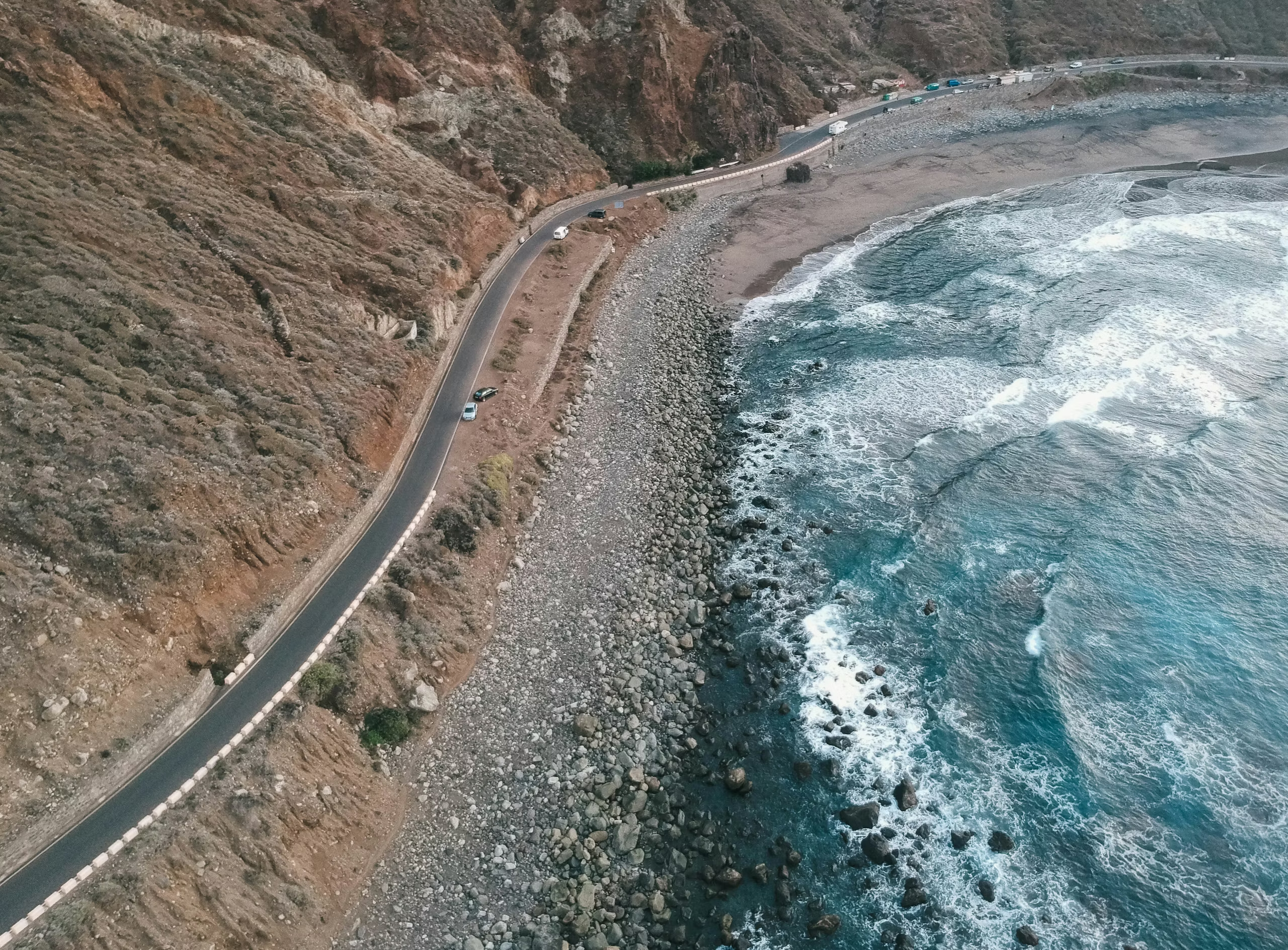
My first pick is the Pacific Coast Highway, especially the California coast when the road is open, the weather is clear, and you are not pretending Los Angeles to San Francisco is a casual one-day drive. It is not. The PCH works best slowly: Malibu, Santa Barbara, Big Sur when accessible, Carmel, maybe Mendocino if you have time. The light has that silver ocean glare in the late afternoon, and the air smells like salt, eucalyptus and overheated brakes. Book the good rooms early. The best coast hotels do not need your last-minute optimism.
Second: the Blue Ridge Parkway. The official route is 469 miles, according to the Blue Ridge Parkway planning site, and the right way to drive it is not to “do” all 469 miles like you are completing paperwork. I like it because it rewards pacing. Asheville, Boone, Roanoke, Shenandoah, lodge nights, porch dinners, fog lifting over the ridges. It is soft, green, and more civilized than people expect, though parts of it can feel remote when your stomach is empty and the next restaurant is thirty-five mountain minutes away.
Third: Route 66, especially in 2026. The road was officially established in 1926, so this centennial year has turned it into a rolling calendar of events, exhibits and restored neon. The historic route stretched 2,448 miles from Chicago to Santa Monica, though the important correction is this: it is not one continuous preserved highway exactly as it was. Large portions are drivable under different names and numbers, and that is part of the texture. A current Route 66 centennial trip needs planning, not just nostalgia and a full tank.
Fourth: the Loneliest Road in America, U.S. 50 across Nevada. This is not for people who need a wine bar every 90 minutes. The appeal is space. Big sky, hard light, long silences, old mining towns, the feeling that the radio is being swallowed by the landscape. The broader U.S. 50 corridor runs more than 3,000 miles coast to coast, but the Nevada stretch is the piece people mean when they talk about loneliness. Scenic often means low infrastructure density, and low infrastructure density means you plan fuel, water and lodging like an adult.
Fifth: Highway 1 down Baja. This one is not technically American once you cross the border, obviously, but it belongs in the American road-trip imagination because so many Californians treat Baja like a long exhale. It can be wonderful: desert, sea, fish tacos, simple inns, serious resorts near the southern end. It can also be uneven, slow, and less forgiving if you treat it like a San Diego weekend with a longer playlist. Check insurance, road conditions, border requirements, and daylight driving. Luxury here is not flash. It is margin.
If you want a domestic re-entry trip before anything more ambitious, my Grand Canyon and Utah route is the kind of landscape-heavy planning that teaches the same lesson: distance on a map and comfort in a day are not the same thing.
International road trips that earn the time
International road trips require a different kind of humility. At home, Americans overestimate what they can drive because the highway system trained us badly. Abroad, we underestimate what a narrow road, left-side driving, weather, sheep, ferries, tunnels, tolls, unfamiliar signs, and one stubborn roundabout can do to the day.
New Zealand’s South Island is one of the rare international drives that lives up to its reputation if you give it enough time. Queenstown, Wanaka, Mount Cook, the West Coast, Marlborough, maybe Fiordland if weather lets you. The distances look manageable, then the road curves, the scenery slows you down, and suddenly a three-hour drive becomes five because you keep stopping. This is not a problem. That is the point. I would rather do eight or ten days well than pretend the whole island can be consumed in one frantic loop.
Ireland’s Wild Atlantic Way is another excellent self-drive route, with one warning: do not let romantic road names bully you into too much mileage. The west coast is made for smaller pieces. Connemara, Clare, Kerry, Donegal — choose sections. The road can be narrow, wet, and emotionally persuasive, which is my polite way of saying you may want to stop every twelve minutes. Build that in. Also build in a real lunch. A road trip powered by scones alone gets weird by 4 p.m.
Iceland’s Ring Road works for planners, not dabblers. It is one of the most satisfying drives in the world when the weather, season, vehicle and lodging are aligned. It is also a place where wind can treat your car door like a loose napkin. Summer is easier, shoulder season is moodier, winter is not for casual drivers. Book in advance, take road closures seriously, and avoid turning every waterfall into a military objective. The memory is better when your hands are not clenched around the steering wheel for seven hours.
Norway’s Atlantic Road is shorter, sharper, and more architectural than the others. Bridges, sea spray, gray light, weather with opinions. I like it as part of a broader western Norway route rather than as the whole reason to fly across the Atlantic. Pair it with fjord country, excellent hotels, and enough time for bad weather. Norway punishes overconfidence with fog.
For international drives, I check government travel advice before I book. The U.S. State Department’s four-level system, and Australia’s Smartraveller travel advice levels, are useful because they separate normal caution from places where reconsidering travel is sensible. This is not about fear. It is about not pretending every map line carries the same risk.
Health prep belongs in the same bucket. The NHS travel vaccination guidance says travelers should ideally seek advice 6 to 8 weeks before departure. For northern and central Europe, North America, and Australia, extra vaccines are often unlikely; for other countries, documentation can matter. A road trip can make you feel independent, but borders and health rules do not care about your mood.
The three-hour rule, and why you will break it once
My road-trip rule is simple: three hours of driving per day is the comfort ceiling. Not three hours total travel time. Three hours behind the wheel. I know Google Maps says four hours and twelve minutes is fine. Google Maps does not know that you want coffee, a bathroom, a photo stop, a decent lunch, a farm stand, a wrong turn, and an arrival that does not involve hating your own vacation.
The three-hour rule is not an official travel-industry standard. It is my editorial rule after enough trips where the day looked easy on paper and felt like a punishment by dinner. Three hours gives you a real morning, a real stop, and a check-in before the front desk staff starts using its night voice. It also leaves space for the thing you did not know you wanted to do until the road gave it to you.
You will break the rule once. Everyone does. Maybe the hotel you want is farther away. Maybe the route has a gap with no lodging worth booking. Maybe you need to cross Nevada, reach Queenstown, make a ferry, or get through a long Iceland segment before weather shifts. Fine. Break it knowingly. Do not build seven broken-rule days in a row and call it a vacation.
The trick is to classify drive days. A transfer day is mostly about getting from one good place to another. A scenic day is about the road itself. A base day is no major drive at all. If every day is both transfer and scenic and base, the itinerary is lying to you.
For luxury travelers, this is where the money should go: better locations, not more stops. A hotel fifteen minutes from the road you want tomorrow is worth more than a larger room forty minutes away. A lodge with dinner on property can save the day after a long mountain road. Valet parking matters in old cities. So does a bathtub when the road has taken your spine personally.
Three things worth doing first
- Mark every day as transfer, scenic, or base before you book hotels.
- Add 30% to map time on rural, coastal, mountain, and international routes.
- Book the hardest-to-replace hotel first, then build the driving around it.
On paper this looks conservative. On the road, it feels rich. The best road trips have air in them. Time to buy peaches. Time to sit by the water. Time to let the view do its job without needing to document it like a crime scene.
Book ahead vs wing it: the threshold by country and season
There is a charming old road-trip idea that you can simply drive until you feel tired, then find a little inn. I understand the appeal. I also understand what it feels like to arrive in a small town at 6:50 p.m. during a festival weekend and learn that the remaining room is above a bar, beside the ice machine, and priced like a junior suite in Manhattan.
Book ahead when the route is famous, seasonal, remote, lodging-thin, or tied to national parks. That means PCH in peak season, Big Sur when rooms are limited, Blue Ridge foliage weeks, Route 66 centennial event periods, Iceland in summer, Norway in high season, New Zealand South Island in January, Ireland during holiday weekends, and any drive where “the next town” is more concept than promise.
Wing it only when the route has lodging density, your standards are flexible, and the season is soft. Midweek shoulder-season drives through parts of New England, inland California, Virginia, or France can allow room for improvisation. But luxury travelers should be honest about what “flexible” means. If you require quiet, parking, good bedding, late dinner, EV charging, air-conditioning, a view, and no weird smell, you are not flexible. You are particular. Own it.
I like a hybrid plan: book anchor nights and leave one or two softer nights open only if the route supports it. Anchor nights are the places that matter most: the lodge near the canyon, the oceanfront room, the inn with the serious restaurant, the hotel after a long drive, the airport-adjacent last night. These are not the places to gamble.
For international trips, I lean more booked than spontaneous. Not because I am uptight. Because arrival logistics, unfamiliar roads, and foreign cancellation terms add enough texture already. I want to know where I am sleeping before I start dealing with left-side driving, rain, and a rental-car manual that appears to have been written by a committee of tiny engineers.
Book direct when the property is small or special. Use a reputable agent when the route has moving parts. Keep cancellation terms in a folder. Confirm parking. Ask about road closures. Ask whether dinner requires reservations. If a hotel says, “Most guests book dinner before arrival,” translate that as: book dinner before arrival.
The danger in winging it is not only a bad room. It is the cascading effect. Bad room, bad sleep, late start, worse breakfast, longer drive, shorter stop, tense dinner. One weak lodging decision can discolor two days. Luxury planning is not about removing surprise. It is about not letting a mediocre motel become the main character.
Turo vs Hertz vs Avis in 2026
The rental car decision is where road-trip romance meets paperwork. Turo can be great. Hertz can be great. Avis can be great. All three can also make you mutter things in an airport garage that would disappoint your grandmother.
Turo is useful when you want a specific car: a Jeep for Utah, a convertible for California, a Tesla for a charging-network test, a nicer SUV than the rental counter is likely to produce. The advantage is specificity. The disadvantage is variability. You are renting from an individual host, which means pickup instructions, cleanliness, maintenance, mileage rules, insurance choices, and communication can vary widely. Read the listing like a contract, not like a vibe.
Hertz and Avis are better when reliability, airport pickup, corporate billing, loyalty status, and quick swaps matter. If a car has a tire-pressure issue or smells like old fries, a major rental company can usually replace it faster than an individual host in a driveway 24 minutes away. Not always. Usually.
For luxury road trips, I choose based on consequence. If the car is part of the experience — say a Pacific Coast Highway convertible, a proper SUV for mountain roads, or a Tesla where charging access matters — Turo may be worth considering. If the car is transportation between hotels, I prefer Hertz, Avis, National, or another major agency with a real counter and a fleet behind it.
Insurance is the unglamorous part. Credit card rental coverage may not apply to peer-to-peer rentals the way you expect. International rentals may have mandatory coverage rules. Some countries require local insurance or documents. Mexico, including Baja, deserves special attention because U.S. auto insurance often does not cover what travelers assume it covers. Read before you drive south, not after someone at the border shrugs.
Also: photograph everything. Tires, windshield, roof, trunk lip, mirror edges, interior stains, fuel level, charging cable, mileage, and any scratch that looks like a cat had a grudge. Do it in daylight when possible. The 90 seconds feels fussy until a dispute arrives six days later, then it feels like self-respect.
For international routes, ask about automatic transmission early. Americans assume automatics are normal because Americans live in a padded rental-car universe. In Ireland, Iceland, Norway, and New Zealand, automatics exist, but the cheaper or last-minute inventory can still make you pay for poor planning. Book the car you can actually drive. Not the car you aspire to master while a sheep watches.
And check luggage fit. A “compact SUV” can mean very different things in Denver, Dublin, and Queenstown. If your suitcases require a visible back seat, you have created a theft invitation. The best road-trip car is not the flashiest. It is the one that holds your bags covered, drives the route comfortably, parks in old towns, and does not make every gas station feel like a docking procedure.
The road-trip food trap
The road-trip food trap starts with one innocent bad breakfast. You say you will grab something later. Later becomes gas-station coffee and a protein bar that tastes like compressed regret. By 2 p.m., everyone is annoyed, and by dinner you are ordering too much because the day has become a blood-sugar apology.
Food is not a side detail on a road trip. It is structural. Bad food timing ruins beautiful days faster than rain. I plan one proper food anchor per day: breakfast before the drive, a lunch stop I actually want, or dinner at the property. Not all three. One. Then I carry enough snacks to prevent personality collapse.
The luxury version is not a cooler full of imported cheese sweating in the trunk. It is smarter basics: water, sparkling water, nuts, fruit, crackers, dark chocolate, electrolyte packets, gum, napkins, hand wipes, and one thing that feels like a treat. In wine country, that might be bread and cheese. In the desert, it is cold grapes and salty chips. In Ireland, it is anything warm at the right moment.
Skip the fantasy of three long restaurant meals every day. On a driving trip, that creates slow mornings, heavy afternoons, and late arrivals. I prefer one proper sit-down meal, one simple meal, and one flexible snack stop. If the hotel has a great restaurant, use it after a long drive. Driving thirty more minutes for dinner after driving all day is the kind of decision that looks cultured at 10 a.m. and deranged at 8 p.m.
In America, the best food stops are often not the fanciest. A good bakery in a Blue Ridge town. A taqueria in California. A diner on Route 66 where the coffee is ordinary but the pie is serious. A roadside produce stand in Utah. Luxury travelers sometimes overcorrect toward reservations and miss the small, regional food that makes a drive feel rooted.
Still, reserve the important dinners. If a lodge has one dining room, book it. If the coastal town has two good restaurants and 900 weekend visitors, book it. If you are traveling in a national park region during peak season, assume everybody else also likes dinner. Because they do.
The road-trip food rule is this: never let hunger make decisions that planning could have made cheaply. A $14 bakery stop can save a $220 bad dinner ordered in fury.
EV road trips: the 2026 reality
EV road trips in 2026 are much easier than they were a few years ago. They are not yet effortless everywhere. Anyone who tells you otherwise is either driving a route with perfect charging density or trying to sell you something.
Tesla still has the cleanest native road-trip charging experience in the U.S. Tesla says its Superchargers can add up to 200 miles in about 15 minutes, and the company advises that charging above 80 percent is rarely necessary on road trips. That tells you the real EV rhythm: short, frequent top-ups, not sitting around waiting for 100 percent because your gasoline brain wants a full tank.
The CCS reality is improving but still more uneven. Some non-Tesla drivers have gained Supercharger access depending on brand, adapter, software, and station compatibility, but that does not mean every charger on the map is yours. Connector type, payment app, charger status, speed, location, and whether the stall is blocked by a confused pickup truck all matter. EV planning is less about range anxiety now and more about infrastructure skepticism.
For luxury travelers, the question is not “Can this be done?” The question is “Will it make the trip better?” On the PCH, a Tesla can be lovely if your hotels have charging or the route has easy Supercharger access. In national park country, it depends. In rural Nevada, parts of Baja, or long remote stretches abroad, I would be cautious. The romance of silence fades when you are eating trail mix in a parking lot waiting for a charger to wake up.
Hotel charging is the new valet parking question. Ask before arrival. Not “Do you have EV charging?” Ask how many chargers, what speed, whether guests can reserve them, whether they are Tesla, J1772, CCS, or universal, and whether they are often blocked. A hotel with one slow charger for 80 rooms does not have an EV charging strategy. It has a conversation piece.
I would happily do a Tesla-native route in California, parts of the Northeast, Colorado, or between major Western cities. I would think harder about a non-Tesla EV on remote scenic drives unless I had verified charging at every critical stop. For international trips, I would rent an EV only if the route is charging-dense and the rental company explains the cable, apps, payment, and return-charge policy in plain English. Otherwise, give me a hybrid. Honestly.
The 2026 EV road-trip framework is simple: plan charging like meals, not emergencies. Build it into the day. Charge while you eat lunch, walk, or check into the hotel. Do not wait until the car is anxious and the humans are worse. And never assume the app is telling the whole truth; read recent charger reviews when the route is remote.
Connectivity matters too. A road trip now runs on maps, charger apps, hotel confirmations, weather alerts, and sometimes offline translation. eSIMs can be useful, with 2025 connectivity sources marketing fast activation and low per-GB data in many countries, but coverage still varies. Download offline maps before the pretty remote road with no bars. Your phone is not brave.
EVs are excellent when the route supports them. They are not a moral achievement you need to force onto every itinerary. The best car is the one that fits the road, the driver, the luggage, the weather, the lodging, and the day’s patience. In that order.
Five Questions People Actually Ask
How many hours should I drive per day on a luxury road trip?
I use three hours behind the wheel as the comfort ceiling. You can break it occasionally, but if every day is five or six hours, you are planning a logistics project, not a trip.
Is Route 66 worth doing in 2026?
Yes, especially because of the centennial, but do not expect one intact 1926 road. Treat it as a heritage route with historic segments, events, motels, diners, museums and plenty of modern interruptions.
Should I book hotels ahead or wing it?
Book ahead for famous, seasonal, remote, coastal, national-park, and international routes. Winging it only works when lodging is dense and your standards are genuinely flexible.
Is Turo better than Hertz or Avis?
Turo is better when you want a specific car and have vetted the host carefully. Hertz and Avis are better when fleet backup, airport logistics, loyalty status, and fast problem-solving matter more than personality.
Are EV road trips easy in 2026?
They are much easier, especially in a Tesla on charger-dense routes. They still require planning, particularly with non-Tesla EVs, remote drives, hotel charging, and international rental setups.
Where to go next?
- Grand Canyon and Utah — a strong domestic road-trip test case for pacing, lodging, desert weather and practical route planning.
- Luxury Travel 2026 — the broader framework for spending carefully and designing trips that feel worth the money.
- Solitaire Lodge New Zealand — useful before planning a South Island drive with lodge stays, weather and long scenic transfers.


