
Last updated: May 2026. Pricing, regulations, and entry requirements may change — confirm current details with operators directly. Check travel.state.gov before booking international travel.
At 8:30 a.m. in a Paris café, an iPhone can make the marble table, coffee foam, and slant of window light look expensive without trying. By noon, the same room turns flat and beige and suddenly everyone wants a “real camera.” After 30+ countries, my travel photography setup is less romantic than people expect: phone first, camera only when the trip earns it. Small bag. Sharp eye. No gear cosplay.
When iPhone is enough — and the 10% when it is not
For most luxury trips, the iPhone is enough. Honestly, more than enough. Hotel rooms, café tables, city corners, beach walks, museum exteriors, train windows, casual portraits, dinner plates before everyone gets impatient — a current iPhone can cover about 90% of what a normal traveler needs if you understand light and do not abuse the zoom.
The iPhone wins because it is already in your hand. That sounds obvious, but it is the whole point. The best camera is not the one sitting in the hotel safe while you are walking through Lisbon with wet hair and a pastry bag. It is the one that catches the tile wall, the waiter’s hand pouring wine, the scarf on the chair, the small thing that would disappear if you stopped to unzip a camera cube.
Current iPhones use Night Mode, computational HDR, and serious image processing to make travel photos look better than they should. It’s limitations show up in the edges: serious low-light interiors, wildlife, fast motion, distant details, large prints, and professional work where files need more latitude. The phone is clever, it is not magic.
The biggest iPhone mistake is digital zoom. Walk closer when you can. Use the main lens when quality matters. Use ultra-wide carefully for rooms and architecture, not for every dinner table unless you want wine glasses shaped like science fiction. If you need a long reach for wildlife or a detail high on a cathedral facade, that is where the phone starts coughing politely.
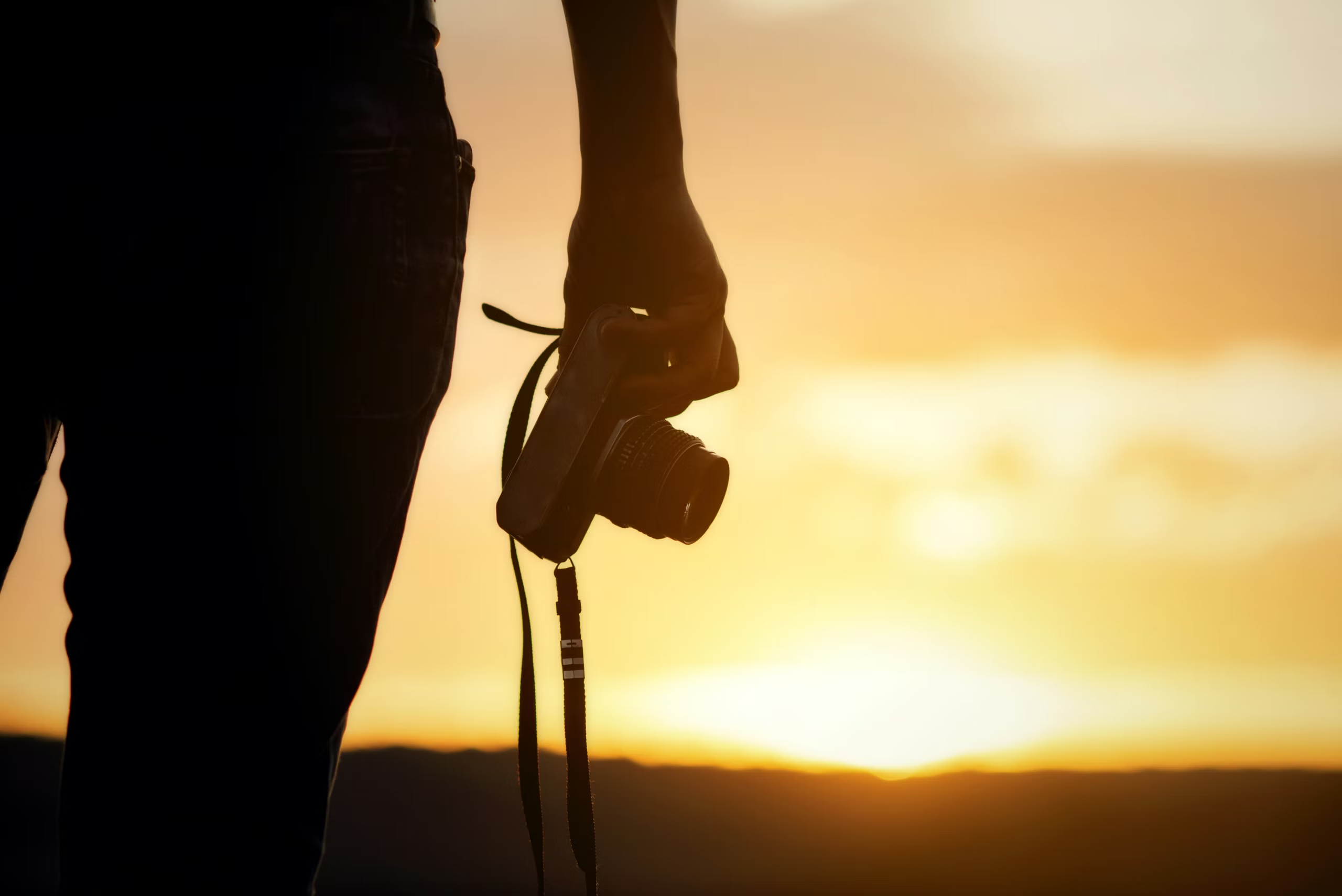
If you need a real camera: Sony A7C II, Fuji X100VI, Ricoh GR
If I pack a camera in 2026, it has to justify its weight every day. Not emotionally. Practically. The three cameras I would consider are the Sony A7C II, the Fujifilm X100VI, and the Ricoh GR series. Different tools. Different personalities.
The Sony A7C II is the grown-up choice: compact full-frame, 33 megapixels, strong low-light files, interchangeable lenses, and enough quality for professional output. It is what I would take for hotels, interiors, wildlife-adjacent trips, print work, or paid content. The downside is system creep. One body becomes two lenses, then a charger, then a strap, then a bag that makes you look like you are covering a summit.
The Fujifilm X100VI is the stylish fixed-lens answer. Around $1,499 MSRP, 40 megapixels, APS-C sensor, and a 35mm-equivalent lens that forces you to see instead of fiddle. It is wonderful for city trips, cafés, portraits, interiors with decent light and street scenes. Less options, better discipline. Also: supply shortages and markups have made it annoying to buy.
The Ricoh GR is the pocket weapon. Tiny, sharp, 28mm-equivalent, street-photography friendly, and almost invisible. I like it for people who want more file quality than a phone but refuse to carry a camera that changes the day. It is not the camera for wildlife, low-light perfection, or zoom lovers. It is for quick, quiet frames. Small, almost too easy to forget.
My verdict: iPhone for 90% of trips, Ricoh for street-heavy city travel, Fuji for one-camera romantic discipline, Sony when the trip has real photographic demands.
The three lenses that earn the bag space
If you carry an interchangeable-lens camera, do not bring the whole drawer. Lenses multiply like hotel slippers. Three types earn space: a wide prime, a fast normal prime, and a telephoto zoom. Everything else needs a very specific reason.
A 24mm or 28mm prime is for architecture, tight streets, hotel rooms, landscapes, and interiors where stepping back is impossible. A 35mm or 50mm fast prime is for portraits, dim restaurants, details, and that editorial feeling where the background softens without looking like fake portrait-mode soup. A 70–200mm zoom is for wildlife, compression, distant details, and anything you cannot politely walk toward.
The trap is packing lenses to accomodate fantasy photos. Are you actually shooting birds? Bring the long lens. Are you mostly doing restaurants, boutiques, and hotel rooms? Leave it. The heaviest lens is always the one you carried for a photo that never occured.
Three things worth doing first
- Decide whether the trip is phone-only, compact-camera, or mirrorless before packing clothes.
- Clean your phone lens every morning, especially after sunscreen, airport snacks and pocket lint.
- Back up photos nightly to cloud storage or an external drive if the work matters.
Editing on iPhone: Lightroom Mobile vs Darkroom
Editing is where travel photos become coherent. Not fake. Coherent. I want the whole trip to feel like one visual memory, not a ransom note of different color temperatures.
Lightroom Mobile is my default when I need control: RAW workflow, presets, selective edits, exposure, color, noise reduction, and sync with desktop. It is not the warmest app in the world, but it behaves like a professional tool. If you shoot iPhone ProRAW or camera RAW, Lightroom makes sense.
Darkroom feels faster and more native to the iPhone. It is excellent for quick edits in the camera roll, especially when I want curves, tone, and a clean export without opening Adobe’s entire universe. Its premium tier is usually less expensive than maintaining a full Creative Cloud habit, though the exact plan depends on what you use.
My edit rule: lower highlights, lift shadows carefully, fix white balance, avoid nuclear saturation, and do not turn every sky into a travel poster. Luxury photos should breathe. The towel can be white. The pasta does not need to glow.
Composition rules that actually matter on a trip
The composition rules I still use are boring because they work: rule of thirds, leading lines, frames within frames, reflections and negative space. You do not need fifty tricks. You need five you remember when a bus is honking and your coffee is cooling.
The rule of thirds stops everything from sitting dead-center like a passport photo. Leading lines pull the eye through a hallway, street, vineyard row, train platform, or pool edge. Frames within frames — windows, arches, mirrors, doorways — add structure when a scene is busy. Reflections give you a second layer without shouting. Negative space makes luxury feel calmer.
One more: foreground. A wine glass, curtain edge, chair back, balcony rail, menu corner. A little foreground can make a hotel photo feel lived-in instead of staged. Not clutter. Context.
For landscape-heavy trips, like my Grand Canyon and Utah route, composition matters more because the scale can flatten in photos. Put something human-sized in the frame: a trail, fence, shadow, boot, hand, car mirror. Otherwise the canyon becomes a postcard with no pulse.
Time of day, and why 11 a.m. is rude
At sunrise cities are soft and underpopulated. By 11 a.m., the light is high, faces squint, white stone blows out, and every plaza starts looking like a stock photo you would reject. Midday is for interiors, lunch, scouting, details, naps and shade. Not hero shots.
Golden hour still works because low-angle light adds warmth and shape. Blue hour — just before sunrise or after sunset — is quieter and better for city lights, water, and hotel exteriors. I often prefer blue hour because fewer people are trying to make a big moment out of it. The air feels cooler, the street lamps click on, the camera stops fighting the sun.
Luxury travel has one useful advantage: good properties look best early and late. Empty pool at 7:15 a.m. Lobby lamps at dusk. Breakfast before the room fills. Turndown light. The polished wood and linen and glass all need angle, not noon.
People photography: the ethics that should be obvious
People are not props for your travel story. This should be obvious, and yet every trip proves it is not. Street photography may be legal in many public places, but legal is not the same as decent. If someone is identifiable and central to the image, especially if you plan to publish it, ask when you can.
The Photo Academy’s street photography ethics guidance makes the useful point that shooting everything and everyone is not the point. Avoid distress, intimacy, visible vulnerability, and people who clearly do not want your camera involved. Your photo is not more important than someone’s dignity.
When in doubt, shoot around the person: hands making pasta, shoes at a café table, a silhouette through glass, textiles, architecture, shadows, reflection. These often make better travel images anyway. If you do ask, be brief and kind. “I’m working on a travel story — may I take a photo?” Then accept no. Not a negotiation.
This matters even more in high-end spaces. A spa, boutique, restaurant, hotel pool, or private guide experience is not a public stage because you paid to be there. Other guest’s paid too.
Five Questions People Actually Ask
Is an iPhone enough for travel photography in 2026?
Yes, for most trips. It handles landscapes, city scenes, food, casual portraits and hotel details beautifully if you understand light and edit with restraint.
When do I need a real camera?
Bring one for wildlife, serious low-light interiors, professional files, large prints, or trips where photography is a main purpose rather than a side benefit.
Sony A7C II, Fujifilm X100VI, or Ricoh GR?
Sony for full-frame flexibility, Fuji for one-camera discipline, Ricoh for pocketable street work. The iPhone still comes with all three.
Should I edit in Lightroom Mobile or Darkroom?
Lightroom Mobile for RAW control and consistency. Darkroom for faster iPhone-native edits with a cleaner feel.
What is the easiest way to improve travel photos?
Shoot earlier or later. Better light fixes more photos than better gear. Annoying but true.
Where to go next?
- Best Travel Apps 2026 — the phone setup that pairs with an iPhone-first photo workflow.
- Grand Canyon and Utah — a practical test case for landscape photography, harsh light, and scale.
- Luxury Travel 2026 — the broader framework for packing less, choosing better, and avoiding glossy nonsense.


