
Last updated: May 2026. Pricing, regulations, and entry requirements may change — confirm current details with operators directly. Check travel.state.gov before booking international travel.
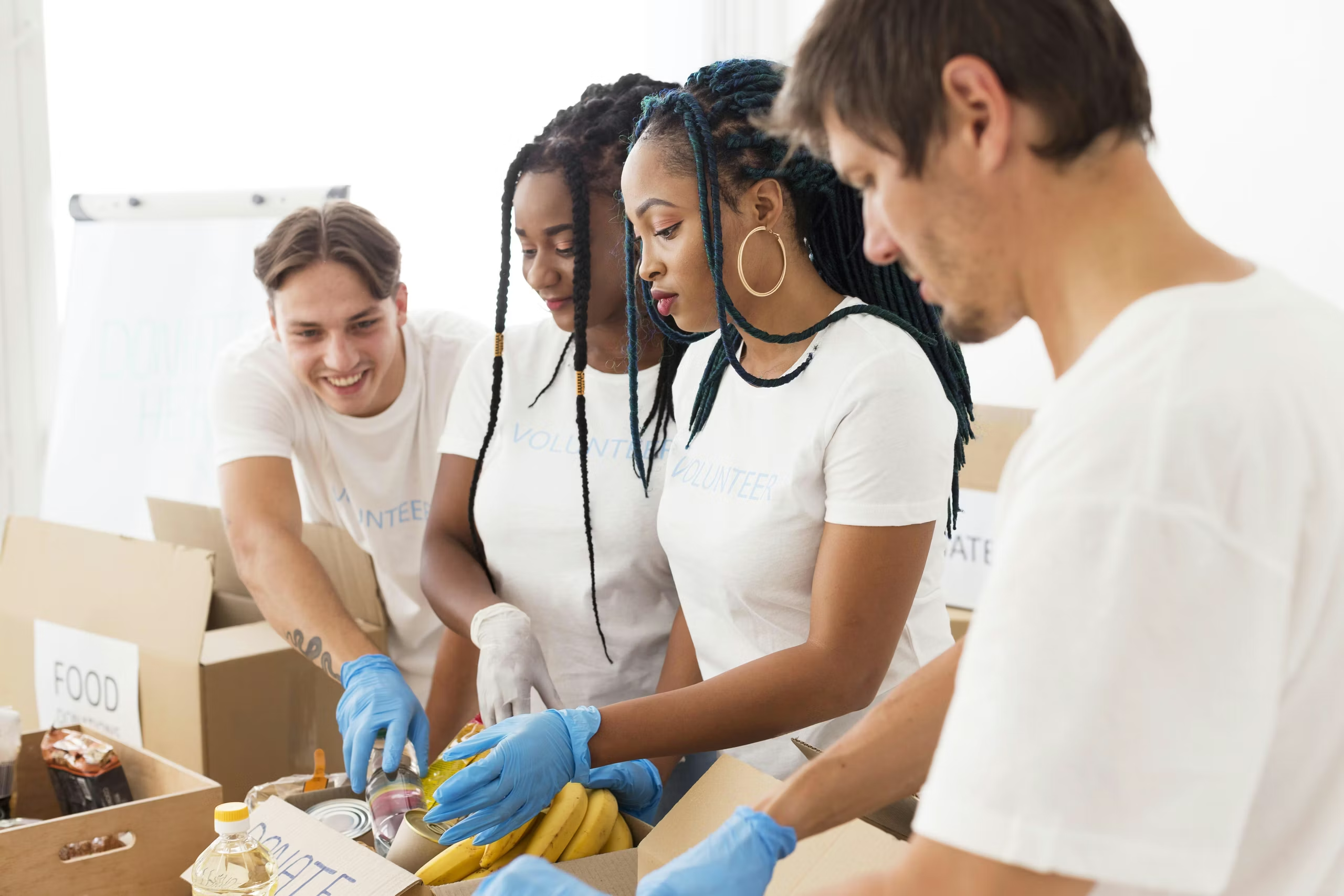
On paper voluntourism sounds like the cleanest kind of travel: see the world, help people, return home with a fuller heart and better photos. Good intentions. The problem is that good intentions have financed orphanage pipelines, replaced local wages, and turned poverty into a guest activity. I do not think the desire to give back is embarrassing. I think the travel industry has sold people a lazy version of it. Here is the better one.
Why most voluntourism harms more than it helps
The first uncomfortable truth: most travelers are not useful enough to justify being inserted into a vulnerable community for a week. I include myself in that. I can write, report, research, edit, ask questions, and organize a trip until the spreadsheet sighs. That does not mean I should teach children in a language I do not speak, build a wall badly, handle wildlife, or become emotionally central to people I will leave on Friday.
Voluntourism works best as a story for the traveler. It gives shape to guilt. It makes privilege feel active. It adds moral texture to a trip that might otherwise be hotels, flights, tasting menus and linen. In luxury travel especially, the contrast is seductive: private pool on Monday, “community visit” on Tuesday, spa on Wednesday. The itinerary feels balanced. That does not mean the impact is.
The problem is power, travelers arrive with money, comfort and access, then mistake proximity for contribution. A short visit can make the volunteer feel transformed while adding work for local staff, disrupting care routines, or redirecting money away from paid local labor. The guest gets the memory. The community gets another cycle of outsiders needing orientation.
I am not saying all volunteering abroad is bad. I am saying the burden of proof is high. If a program involves children, medical care, wildlife, construction, education, or trauma, the default question should not be “How can I help?” It should be “Why am I the right person to do this, and who would be paid if I did not show up?” A useful discomfort.
That question changes the whole trip. It moves you away from photogenic charity and toward effectiveness: locally owned operators, long-term community organizations, skilled professional placements, research-backed conservation, and funding mechanisms that do not require your body to be present for your money to matter.
The orphanage tourism problem
In Cambodia orphanage tourism is the example I wish every luxury traveler understood before booking anything described as “heartwarming.” Research and child-protection groups have repeatedly found that many children in Cambodian orphanages are not orphans. Families may be persuaded that institutions offer better education, food, foreign support, or opportunity. Then foreign donations and visits make the institution financially viable. The child becomes part of the business model.
That is not a small ethical wrinkle. It is the center of the problem. If children are separated from families because institutions can attract visitors and money, then the volunteer trip is not helping orphans. It is helping create demand for them.
Nepal has faced similar criticism. Child-protection researchers have described orphanage voluntourism there as a driver of displacement and unnecessary institutionalization, especially when rural families are told that a child will receive better care in a children’s home. The result can be devastating: children with living families are presented to outsiders as objects of rescue.
The Better Care Network and Rethink Orphanages are blunt about this: travelers should avoid orphanage visits and redirect support toward family-based care. ECPAT has also warned that voluntourism-style access to children can create serious safeguarding risks, especially where background checks, oversight, and child-protection laws are weak.
The most disturbing part is how ordinary it can look. A clean room. A smiling director. Children singing a song. A volunteer invited to help with homework. Kids become the attraction, the room becomes a stage. Nothing has to look sinister for it to be wrong.
If a program lets untrained travelers walk into a children’s home and build emotional relationships with children for a few days or weeks, I do not care how tender the brochure sounds. No. Children are not there to educate visiting adults about gratitude. They need stable, long-term care from screened professionals and family-centered systems. Not a revolving door of strangers with cameras.
This is where the white savior critique is not an academic insult. It is a description of a pattern: Western traveler arrives, local suffering becomes the backdrop, the visitor performs care, then leaves with moral proof. The child stays. The staff stays. The structural problem stays. Its not a fair exchange.
The voluntourist gap: paying for what should be a wage
At its worst voluntourism asks foreigners to pay for the privilege of doing work a local person could be paid to do better. That is the voluntourist gap. You pay $1,200 for a two-week placement. A local teacher, caregiver, translator, driver, carpenter, field assistant, or community worker may earn a fraction of that. The program sells your participation as generosity, while the local labor economy absorbs the distortion.
This is especially ugly in childcare, teaching, and basic construction. If you are not qualified to teach in Brooklyn, why would you be qualified to teach in rural Nepal? If you would not be allowed to walk into a daycare in Boston and hug children after a short orientation, why would it be fine abroad? If the wall you build needs a local worker to fix it later, who helped whom?
The math is ugly. Some voluntourism studies and media analyses have found that only a small share of program fees may reach host communities, with much of the money going to marketing, administration, accommodations, Western agency overhead, and profit. Even if the exact percentage changes by operator, the core question remains: how much of what you paid stays where the need is?
Luxury travelers need to be especially honest here because we know what good service costs. We know private transfers, guides, hotel staff, chefs, porters, drivers and concierges do real work. Yet many travelers suddenly forget wage logic when a program is labeled “volunteer.” If work matters, someone local should probably be paid to do it. If your presence is truly needed, the program should be able to explain why.
Ask the sharp questions before booking:
- What percentage of my fee goes directly to the local partner?
- Would a local person be paid to do this work if I did not come?
- What qualifications, background checks and training are required?
- Are children, patients, or vulnerable adults involved?
- Who requested this project: the community, the operator, or the traveler market?
- What happens after volunteers leave?
- Can I fund the work without physically participating?
If the answers are vague, sentimental, or hostile, walk away. A serious organization will not be offended by serious questions. A business selling emotional access might be.
White savior optics are not the main problem. Power is.
People get defensive around the phrase “white savior,” partly because it sounds like a personal accusation. Sometimes it is. More usefully, it describes a system where Western comfort, money, and storytelling become the center of someone else’s hardship.
If a program needs photos of Western volunteers with local children to sell the next trip, that is not a small branding choice. It tells you who the product is built around. If testimonials focus on how the volunteer “learned so much” but say little about measured community outcomes, that is also a clue. If a trip promises transformation for you, but cannot show durable benefit for locals, the ethical center is in the wrong place.
The white savior issue is not only race, though race often matters. It is about whose expertise counts. Whose grief is displayed. Whose language is ignored. Whose labor is underpaid. Whose children become available to strangers. Whose community gets described as “needy” so a traveler can feel necessary.
Luxury travel makes this sharper because the contrast can be obscene. You can fly business class, sleep in a $700 room, then spend two hours “serving” in a community where local staff are doing the real work all year. If a program sells that contrast as depth, be careful. Poverty should not function as an accessory to self-discovery.
This does not mean you should stop caring. It means care should become less performative and more accountable. Give money without needing a hug in return. Hire local professionals. Fund salaries. Support family-based care. Choose tours that keep ownership local. Pick conservation projects with published research output. Lend through platforms where the recipient is a business owner, not a prop in your story.
The best giving is often quiet. No group photo. No emotional caption. No child’s face. Just money, partnership, competence and humility. Less rewarding for social media. Better for humans.
When voluntourism actually works
Volunteering abroad can work when the traveler brings a real skill, stays long enough to be useful, passes serious screening, receives cultural training, works under local leadership, and fills a role that cannot reasonably be filled by a paid local worker. That is a narrow lane. It should be.
With Médecins Sans Frontières, for example, the model is professional. Doctors, nurses, logisticians, engineers, administrators, mental-health specialists, and other qualified staff are placed according to need. These are not “come for a week and feel useful” trips. They usually require serious credentials, screening, difficult placements, and longer commitments. That is not voluntourism in the casual sense. It is work.
Habitat for Humanity’s Global Village model is more accessible, but the better versions still matter because participants work alongside local teams and households rather than replacing an entire local workforce. The Habitat for Humanity international volunteer structure has been evolving, with 2026 programming emphasizing organized groups and local community hiring in some communications. It is still not automatically perfect, but it has more structure than “show up and fix poverty with a hammer.”
Cross-Cultural Solutions sits in the middle ground. Its best argument is training, orientation, and community-based placement rather than child-facing orphanage-style access. I would still ask hard questions: who requested the project, what safeguards exist, what local workers are paid, and whether the placement can accomodate continuity after volunteers leave.
The pattern is obvious. Good volunteering is less convenient. It requires credentials, checks, time, humility, and limits. Bad voluntourism is easy to buy. A few clicks, a deposit, an airport pickup, and the promise that you will matter immediately. Convenience is not proof of ethics.
If you are a lawyer, doctor, nurse, engineer, grant writer, accountant, translator, therapist, researcher, builder, educator, or logistics professional, maybe your skill has a place. If you are simply a kind traveler with money and a week, your money may be more useful than your week. That is not an insult. It is efficiency.
Conservation programs with research output
Conservation volunteering is not automatically ethical either. A program can be just as performative with turtles as it is with children. “Plant trees,” “save wildlife,” “marine conservation,” “help researchers” — all lovely words. What matters is whether the project produces usable data, supports trained local staff, follows scientific protocols, and does not disturb the ecosystem it claims to protect.
For conservation I want evidence. Is there a university partner? Are data sets published or shared with government agencies, NGOs, or park managers? Are volunteers trained before entering the field? Are wildlife interactions observational, not hands-on? Are local rangers, scientists, and guides paid? Is the work needed even when no foreign volunteers are present?
The real conservation projects are often less photogenic than the fake ones. You count nests. Record coordinates. Carry equipment. Sit quietly. Enter data. Follow a protocol. Do not touch the animal. Do not wander off because the sunset looks good. It can be repetitive, muddy, humid, buggy, and not especially Instagrammable. Good.
Wildlife is not there to heal your burnout. It is not a luxury add-on to a safari. If a conservation program lets tourists cuddle, bottle-feed, ride, chase, handle, or stage wildlife, I am out. Real conservation usually creates distance. Bad tourism sells closeness.
This is where luxury travelers have an opportunity to fund seriousness. Instead of paying for a high-touch “volunteer experience,” pay for a lodge with verified conservation partnerships. Fund a ranger program. Hire a local naturalist. Choose an operator that supports research and publishes outcomes. For rainforest planning, I made the same argument in my Amazon eco-luxury guide: the land and the people working on it matter more than the emotional packaging.
If a conservation program can explain what data it collects, who uses the data, and how local people are paid, keep reading. If it mostly explains how meaningful you will feel, close the tab.
Locally owned operators are usually the better alternative
The simplest alternative to voluntourism is not another volunteer trip. It is better spending. Locally owned tour operators, guides, lodges, restaurants, transport companies, and community-run experiences can keep money in the destination without asking travelers to pretend they are temporary social workers.
Instead of teaching for a week, hire a local educator as a guide. Instead of painting a school badly, fund maintenance through a vetted local organization. Instead of visiting an orphanage, support family-based care. Instead of “helping” at a community project you do not understand, book a locally owned experience and pay full price without haggling it down to a moral victory.
Microloans can also be useful if you understand their limits. Kiva lets people lend small amounts to entrepreneurs around the world. It is not perfect, and microfinance has its own debates, but the model is cleaner than parachuting into a community to do work you are not qualified for. Money goes toward a person’s stated economic activity. You do not need to be photographed holding anyone’s child.
For luxury travelers, the best giving often looks like procurement. Where does the hotel buy food? Who owns the excursion company? Are guides freelance and fairly paid? Does the lodge hire locally into management roles, or only service roles? Does the itinerary include community businesses that would exist without tourist pity? This is less emotionally tidy than “volunteer day.” It is also more respectful.
I am not against structured visits to community projects when they are locally led, transparent, and not built around vulnerable people performing gratitude. A cooperative visit, artisan workshop, farm tour, conservation briefing, or community-owned lodge can be excellent. The difference is consent, ownership, and whether the community is selling a product or being turned into one.
This is also why I care about sustainable travel more broadly. In my sustainable travel 2026 guide, I argue that the lowest-impact luxury trip is usually the one that changes structure: longer stays, fewer flights, locally owned lodging, better operators. The same logic applies here. Giving back should not be a decorative half-day. It should be built into how money moves.
What I do instead — and why
I do not book orphanage visits. I do not volunteer with children abroad unless there is a serious professional framework, screening, continuity, and a reason I specifically should be there. I do not handle wildlife. I do not buy “poverty immersion.” I do not confuse discomfort with depth.
What I do instead is less dramatic. I hire local guides. I choose locally owned hotels when they are good. I pay for tours that employ specialists. I support conservation programs with real outputs. I lend or donate to organizations that do year-round work. I ask hotels where their community funds go. I avoid photographing children in vulnerable settings. I tip properly. I buy directly from makers. I stay longer when I can.
None of this gives the same emotional hit as a volunteer photo with a child. That is precisely why I trust it more. Effective help often feels less cinematic. More like an invoice, a salary, a scholarship fund, a local business, a research budget, a guide’s fee, a family kept together, a forest ranger paid on time.
For Americans who genuinely want to help, my advice is not “do nothing.” It is: stop centering yourself as the delivery mechanism. Ask what local people are already doing. Fund that. Learn from that. Travel in ways that do not create new burdens. If you have a serious skill, offer it through a serious channel. If you do not, let money, attention, and purchasing power do the work.
This matters because the desire to give back is not the problem. The marketplace around that desire is. It has learned how to sell moral emotion in convenient increments: one week, three meals included, airport pickup, children available, transformation promised. Hard pass.
The better trip may look quieter. A locally owned inn. A guide who talks about his own community without flattening it for outsiders. A conservation briefing where the scientist says “please do not touch anything.” A donation that never appears on your Instagram. A microloan. A full-price booking with a local operator. A family-based care organization that prevents institutionalization instead of inviting strangers into the institution after the damage occured.
That is not less generous. It is less theatrical. There is a difference.
Five Questions People Actually Ask
Is all voluntourism bad?
No. Skilled, locally requested, well-screened, long-term or professionally supervised volunteering can help. Short-term, child-facing, unskilled work sold to travelers is where the ethical risk gets loud.
Why is orphanage tourism so harmful?
Because it can create demand for institutions, separate children from families, expose children to a stream of strangers, and reward organizations for keeping kids visible to donors.
What if I just want to visit and bring donations?
Do not visit children’s institutions. Give through vetted family-based care organizations, local NGOs, or community programs that do not use children as donor-facing proof.
Are Habitat for Humanity trips ethical?
They can be, especially when local labor is paid, communities request the work, and volunteers understand they are supporting—not replacing—skilled local workers. Read the current program details before booking.
What is the best alternative to volunteering abroad?
Spend locally, hire local guides, support conservation with measurable outputs, fund family-based care, and use platforms like Kiva or vetted NGOs. Often your money is more useful than your presence.
Where to go next?
- Sustainable Travel Real Guide — the broader framework for spending better without falling for glossy impact language.
- Solo Eco Travel Guide 2026 — useful if you want lower-impact travel that does not rely on performative volunteering.
- In the Heart of the Amazon — a practical next read on conservation, local operators, and rainforest travel with fewer illusions.