
Last updated: May 2026. Pricing, regulations, and entry requirements may change — confirm current details with operators directly. Check travel.state.gov before booking international travel.
The most expensive money mistake I see abroad is not theft. It is the quiet little USD button on a card terminal in Paris, Rome, or Amsterdam, glowing like it’s doing you a favor. It is not. After 30+ countries, my travel payment setup has become less about points theater and more about control: one strong credit card, one ATM card, one backup wallet, and enough cash to solve a small problem.
The four-card setup I actually use
My international payment stack is boring by design. Boring is good when you are standing in a hotel lobby at 11:40 p.m. with jet-lag breath, a dead phone, and a front desk agent who needs a working card before handing over the key envelope.
The first layer is a no-foreign-transaction-fee travel credit card. For many Americans, that means something like the Chase Sapphire Preferred, which has a $95 annual fee and no foreign transaction fees, or the Capital One Venture X, which sits in the premium-card lane with a $395 annual fee. The Amex Platinum also has no foreign transaction fee, though its $895 annual fee in 2026 means I want real lounge, hotel, and statement-credit use before calling it sensible.
My second layer is a debit card built for ATMs, not a random checking-account card that charges you twice for the privilege of getting cash. Third: a multi-currency app card, usually Wise or Revolut, for smaller purchases and backup access. Fourth: a card stored in Apple Pay or Google Wallet that is not the same physical card in my wallet. If the wallet disappears, dinner still happens.
Do not carry six cards because a points forum made you anxious. Carry enough redundancy to accomodate a decline, a lost card, and one network outage. That is the line.
Wise vs Revolut — which one and when
Wise is the cleaner tool for people who care about seeing the math. The Wise pricing page lays out conversion fees and ATM limits clearly, and the appeal is simple: hold euros, pounds, francs, or other currencies, then spend from that balance without guessing what spread got buried in the exchange rate.
In Europe I like Wise for cafés, museum shops, casual taxis, train snacks and the kind of 18-euro pharmacy run that should not touch my main credit card. The app feels practical, not glamorous. Fine by me. I want my money app to behave like a good editor: show the cost, cut the nonsense.
Revolut is more lifestyle-shaped, with plan tiers and monthly allowances that can work well if you know your limits. Its fee schedule matters because free exchange and ATM allowances vary by plan. If you blow past a free monthly allowance without noticing, the elegant app starts looking less elegant.
My rule: Wise for transparent currency handling, Revolut if you already use it and understand your plan. Do not use either as your only payment method. Apps freeze, phones die and hotel WiFi has a talent for failing exactly when you need a verification code.
The Schwab or Fidelity debit card for ATM cash
A good ATM debit card is not sexy. It is the umbrella you are grateful for when the sky opens. Charles Schwab’s Investor Checking debit card has long been the American traveler favorite because it is designed around ATM use abroad, including foreign ATM fee reimbursements. Fidelity’s Cash Management debit card has also become more useful for international travelers, with no foreign transaction fee on purchases and ATM-fee reimbursement for eligible accounts.
This is not where I use a regular Bank of Wherever debit card. Many ordinary U.S. debit cards still hit travelers with foreign transaction fees, ATM operator charges, weak withdrawal limits or all three. The bad version is ugly: you withdraw €200, the ATM charges a fee, your bank adds a fee, the machine offers a lousy dollar conversion, and suddenly your “quick cash” has the financial texture of wet cardboard.
Before a trip, I check the daily ATM limit, set a travel notice if the bank still uses them, and confirm the PIN. Not the app password. The actual card PIN. In much of Europe, chip-and-PIN is still part of the payment plumbing, especially at ATMs, fuel stations, ticket machines, and smaller merchants.
One more thing: withdraw from bank ATMs when possible, not mystery machines glowing next to souvenir shops. The safer-feeling lobby ATM at a real bank is worth the extra two blocks, it usually gives you less drama.
Cash — how much, where to get it, where you do not need it
After landing I usually pull the equivalent of $100 to $200 in local currency from a bank ATM. Less bills, better control. I want enough for tips, a taxi problem, a market stall, a bathroom attendant, or a café whose terminal has apparently chosen personal growth through failure.
I do not buy big stacks of foreign currency from U.S. airport counters before leaving. The rates are usually poor, and the whole thing feels like paying a convenience tax while fluorescent lights hum overhead. Hotel-lobby exchange desks can be even worse. A bad rate on €300 can quietly cost the price of a very nice lunch.
Where is cash still useful? Southern European taxis that “prefer” it, small Italian towns, rural markets, tips for guides, bellhops, housekeeping, and occasional train-station bathrooms. Where is it often unnecessary? London, Amsterdam, Stockholm, Copenhagen, and many parts of Spain, where contactless payments have become so normal that pulling out bills can feel like opening a flip phone.
Luxury does not mean cashless. Luxury means not being stuck.
The dynamic currency conversion trap
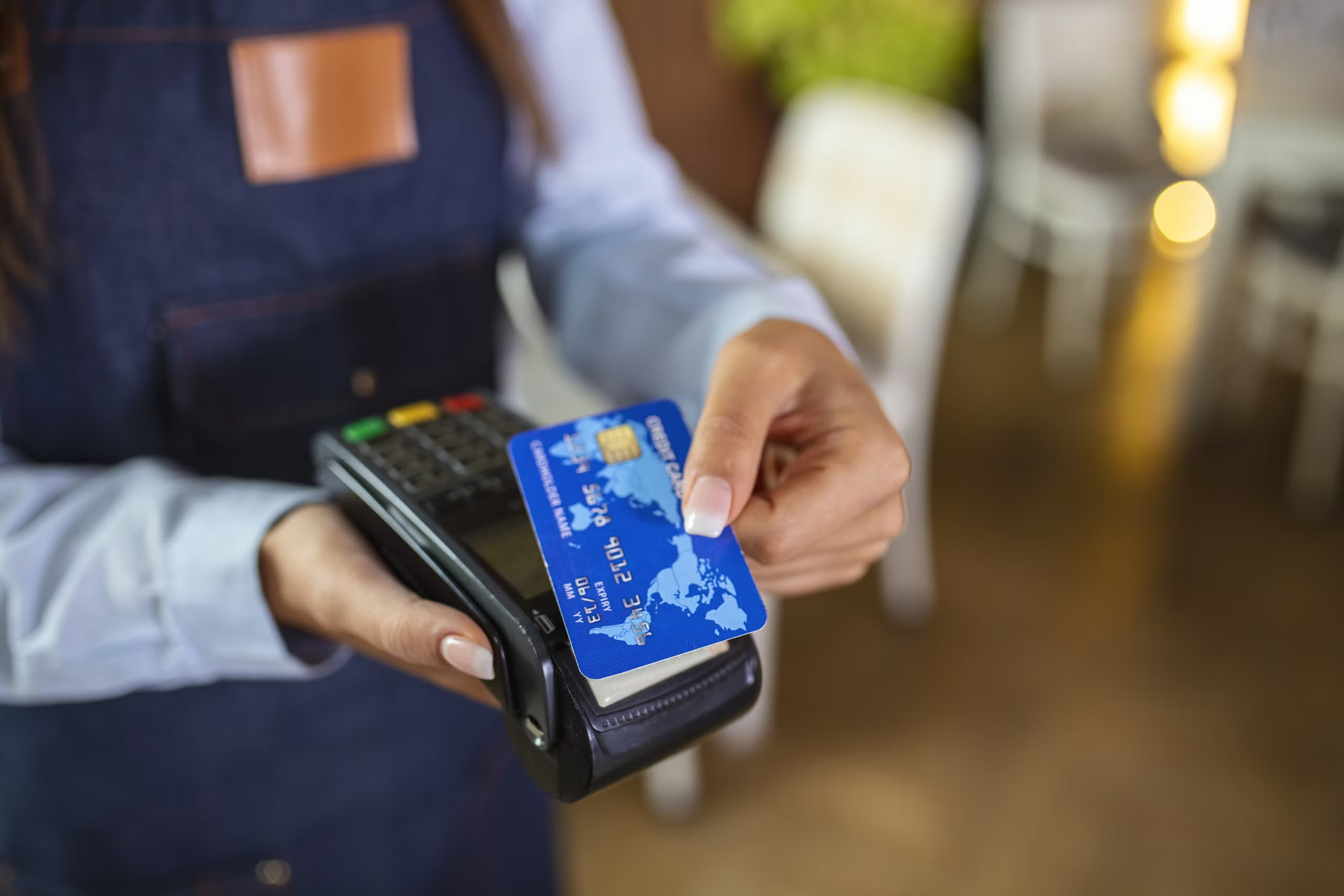
Dynamic currency conversion, or DCC, is the travel-fee trap I hate most because it looks polite. The terminal asks if you want to pay in U.S. dollars instead of euros, pounds, pesos, or francs. The waiter may even say, “For your convenience.” Hard no.
DCC lets the merchant or ATM provider set the conversion rate, and that rate is often much worse than what your card network would use. Visa’s own dynamic currency conversion guidance says the terminal should show both currencies, the exchange rate, and any markup, and that you should be able to decline. In real life, you need to be awake enough to notice the prompt.
My script is simple: always choose local currency. In France, pay in euros. In the U.K., pay in pounds. In Switzerland, pay in francs. If the machine shows dollars, pause. That is usually the wrong button.
The sneakiest version happens at hotels and boutiques. Someone “helps” you through the terminal, the dollar amount appears, they tap quickly, its done. Do not let them. Smile, slow it down, and ask for local currency. Firmly. This is one of those tiny travel muscles that saves real money over a year.
Contactless reality by country in 2026
In 2026 contactless is no longer a novelty in most places American luxury travelers go. It is the normal way to buy coffee in London, tap into transit in many cities, pay for a museum postcard, or settle a bar tab without handing over the card.
The U.K. is extremely contactless-friendly. The Netherlands and Scandinavia are even more card-forward in many daily situations. Spain is smooth in major cities. France is easy in cities and hotels, though small merchants may have minimums. Italy is much better than it was ten years ago, but I still keep cash for taxis, rural cafés and small family-run shops. Germany is the one where I stay alert: cards are common in cities and hotels, but cash still has more cultural gravity than Americans expect.
Contactless limits vary by country, bank and terminal. Many small taps go through without a PIN, while larger transactions may ask for one. This is why I want my phone wallet, physical card, and PIN all ready. Not one of the three. All three.
For trips that mix lodge stays, city hotels, and remote transfers — the kind of planning I talk about in my luxury travel 2026 framework — I assume the city will be tap-friendly and the beautiful remote place will occasionally act like the internet was invented yesterday. Both can be true.
What to do when a card is declined abroad
Card declines abroad have a sound. A small, ugly buzz. Then the terminal gets handed back like it contains disappointing news about your character. It is rarely personal. Usually it is a PIN issue, fraud filter, network hiccup, contactless limit, or DCC confusion.
First, try the same card inserted instead of tapped. Second, try the PIN. Third, ask the merchant to run it in local currency. Fourth, use a different network — Visa if Amex failed, Mastercard if Visa failed. Fifth, step outside and approve the bank alert if one arrived. If you are in a basement restaurant with stone walls, your phone may be the problem, not the card.
Keep one backup card away from your main wallet. I usually keep mine in a zipped pouch or hotel safe, depending on the day. If your entire payment life is in one cardholder and that cardholder vanishes, you’re trip becomes an administrative errand with room service.
If fraud blocks occured, call the number in the app or on the back of the card using WiFi calling. Do not click random text links. Do not read card numbers out loud in a lobby. And do not panic-pay with DCC just because the first attempt failed. Slow down. Travelers lose money when they hurry.
Five Questions People Actually Ask
Should I use Chase Sapphire Preferred, Venture X, or Amex Platinum abroad?
Use the one whose benefits you actually use and whose network works where you are going. Visa and Mastercard are generally broader abroad; Amex is excellent in many luxury hotels and restaurants, but less universal at small merchants.
Do I still need cash in Europe?
Yes, but not a brick of it. I like $100 to $200 equivalent for tips, taxis, markets, and payment-terminal failures.
Is Wise better than Revolut?
Wise is better if you want transparent fees and simple currency balances. Revolut can be excellent if your plan allowances match your spending and you pay attention to limits.
What should I choose when the terminal asks USD or local currency?
Choose local currency. The USD option is usually dynamic currency conversion, and it can cost meaningfully more.
What is the best backup payment method?
A second no-foreign-fee card on a different network, plus a debit card for ATMs and a phone wallet. Not glamorous. Very effective.
Where to go next?
- Luxury Travel 2026 — the broader framework for spending well, choosing better hotels, and avoiding expensive nonsense.
- Solitaire Lodge New Zealand — useful if you want to see how payment planning fits remote luxury stays.
- In the Heart of the Amazon — a good reminder that cash, cards, and connectivity need different plans outside major cities.


