
Last updated: May 2026. Pricing, regulations, and entry requirements may change — confirm current details with operators directly. Check travel.state.gov before booking international travel.
At 7:15 p.m. in a train station, safety is not a money belt or a dramatic fear story. It is knowing which exit is busy, which taxi line is official, where your backup card is, and whether the hotel has your passport copy. After 30+ countries, my safety setup is boring on purpose. Not paranoid. Not casual. A layered system for staying alert without letting anxiety run the trip.
The State Department advisory system: what the tiers actually mean
The first thing I check before booking international travel is the U.S. State Department advisory level. Not because I think government pages capture every street-level nuance. They do not. But they give me a baseline, and baselines matter when the internet is busy turning every destination into either a threat or a fantasy.
The State Department travel advisory system uses four levels: Level 1, Exercise Normal Precautions; Level 2, Exercise Increased Caution; Level 3, Reconsider Travel; Level 4, Do Not Travel. The mistake I see constantly is treating Level 2 as “dangerous.” It is not that simple. France, Italy, Spain, the U.K., and Germany have all appeared at Level 2 due to terrorism concerns, and Americans still travel there every day without needing to behave like they are entering a war zone.
Level 2 means read the details. It means understand the reason for the advisory. Terrorism threat is different from violent crime, civil unrest, kidnapping risk, arbitrary detention, weak health infrastructure, or a region-specific warning. It’s job is not to decide your trip for you. It is to make you ask better questions.
Level 3 is where I slow down. Reconsider Travel does not mean “never,” but it does mean I need a strong reason, excellent logistics, insurance that matches the risk, and a guide or operator I trust. Level 4 is different. Do Not Travel means the government is telling you the risks are severe enough that you should not go. Travel + Leisure reported 22 countries on the U.S. Do Not Travel list in 2026, and that is not a list I treat as travel inspiration.
I also register some trips with STEP, the Smart Traveler Enrollment Program, especially when I am traveling solo, going somewhere with active political uncertainty, or moving through multiple regions. STEP is not glamorous. Neither is needing embassy alerts and not having them.
The advisory tier is the start. Then I read recent local news, hotel neighborhood notes, transportation warnings, weather patterns, and health guidance. Safety is not one red or green light. It is a dashboard.
Travel insurance that pays: World Nomads, IMG, Allianz
Before buying insurance I separate marketing from claims. Every provider sounds wonderful before the trip. The question is what happens after the bag is lost, the knee is twisted, the flight is canceled, or the doctor says you cannot continue. That is where policy language and claims discipline matter.
I am not going to pretend there is a clean public payout ledger for every insurer. There usually is not. What I look at instead is coverage fit, claims process, exclusions, medical and evacuation limits, activity coverage, deadlines, and whether the provider has a pattern of making the right thing easy or miserable.
World Nomads is strongest for adventure-leaning travelers. A 2025 MoneyGeek analysis gave World Nomads a high overall score and highlighted its coverage of 250+ adventure activities. That matters if your trip includes hiking, kayaking, diving, snow sports, or the sort of “light adventure” hotels sell as if risk politely disappears when the guide wears linen. World Nomads can also appeal to travelers who extend trips while already abroad, depending on plan and location.
The caveat: adventure-friendly does not mean universally best. World Nomads has specific claim documentation timelines, exclusions, secondary medical structures in some contexts, and support realities you need to read before relying on it. Less people would be disappointed if they read the certificate before they needed the certificate.
IMG is the provider I would compare when medical coverage and customization matter. It tends to feel broader and more medical-forward, with more plan variation. That can be useful for longer trips, medically cautious travelers, remote itineraries, and people who do not fit the simple vacation box. If a trip has a serious health or evacuation angle, IMG belongs in the research pile.
Allianz is the mainstream name I associate with claims infrastructure. The same MoneyGeek comparison scored Allianz particularly well for claims and service. That does not mean every claim is easy or every plan is generous. It means the company belongs in the quote comparison for classic luxury trips: prepaid hotels, cruises, flights, tours, family travel, and large deposits.
My practical take: World Nomads for activity-heavy trips, IMG for medical customization, Allianz for conventional luxury coverage and claims structure. Then compare the actual plan. Not the brand halo. Not a travel forum comment from 2019. The current plan.
Medical evacuation: when Global Rescue or Medjet earns the fee
Medical evacuation is the category people ignore until the number gets grotesque. Emergency medical coverage pays for care. Evacuation coverage pays to move you to care or home, depending on the service and plan. Those are not the same.
This matters for safaris, remote islands, small ships, mountain trips, rural road trips, expedition cruises, and any itinerary where the nearest good hospital is not actually near. Global Rescue has warned through travel-risk partnerships that an emergency evacuation in Africa can cost up to $300,000. That is not a “maybe I should have bought the premium economy seat” number. That is house-money.
Global Rescue and Medjet are not the same as ordinary trip insurance. They are membership-style medical transport and security services, depending on plan. Medjet is often discussed for transport to a hospital of your choice once you are hospitalized away from home. Global Rescue is known for field rescue and security-focused assistance. Read the current rules. The promise lives in the definitions.
When do I consider this layer? Safari. Remote lodge. Expedition ship. Ski trip with off-piste temptation. Long driving route in low-coverage areas. Solo travel where I do not want my emergency plan to rely on the kindness of whoever answers the hotel phone at 2 a.m. Not every Paris weekend needs evacuation membership. A Galápagos ship, Botswana camp, Patagonia lodge, or remote Alaska itinerary might.
Credit card coverage is not automatically enough. Some premium cards include evacuation benefits, but the limits, eligibility, coordination, and transport rules may not accomodate the trip you think you bought. The question is not “Do I have something?” The question is “What happens, exactly, if I need to leave a remote place injured?” Different question.
For a deeper insurance breakdown, I laid out the policy mechanics in my travel insurance comparison 2026. Safety and insurance overlap, but they are not twins. Safety reduces the chance. Insurance reduces the damage.
What I actually carry, and what over-prep looks like
I do not carry a survivalist pharmacy or enough cables to wire a small conference room. Over-prep creates its own friction. Heavy bags, cluttered thinking, too many hiding places, too much “just in case” gear. The point is not to feel armored. The point is to solve predictable problems quickly.
My real carry list is small: passport, phone, backup card, a little cash, hotel address offline, insurance card or PDF, medication in original packaging, one mask, hand sanitizer, power bank, eSIM or roaming plan, and emergency contacts saved offline. For longer or more remote trips, I add a small flashlight, blister kit, electrolyte packets, and printed copies of the most important documents.
The old “photocopy in your hotel safe” habit is half right and half outdated. A photocopy cannot replace your passport. But a paper copy can help with a police report, hotel issue, border checkpoint, or embassy conversation. My current system is layered: password-protected digital scan in cloud storage, a copy in secure password storage, one paper copy in luggage, and sometimes the real passport in the hotel safe if I do not need to carry it. Your not safer because one copy exists. You are safer because the copy is accessible when the original is not.
Hotel safes are useful, not sacred. Some rooms do not have them. Some safes are badly mounted. Some are fine for passport and jewelry while you go to dinner. I do not store everything valuable in one place. One backup card and a little cash live separately from the main wallet. If the wallet disappears, the day gets annoying, not catastrophic.
I do not like the theatrical decoy-wallet thing for every traveler. It can be smart in some places if you know what you are doing, but constantly fiddling with hidden pouches in public tells observant people where the real valuables are. A better habit: carry less, divide essentials, and stop checking your “secret” pocket every six minutes.
Three things worth doing first
- Save passport, insurance, hotel and emergency-contact PDFs offline before departure.
- Put one backup card and $100 equivalent away from your main wallet.
- Send your itinerary to one trusted person who will notice if you go quiet.
Situational awareness: the three skills that matter
Situational awareness sounds like something said by a man in cargo pants. In practice, it is quieter. It is noticing the room before the room notices you. It is not walking while staring into your phone. It is knowing when the energy of a street has changed.
The first skill is baseline reading. When I enter a new area, I spend a few minutes noticing normal: who is there, how people move, what the sound level is, where families are, where staff stand, how traffic behaves, where the exits are. Once you have a baseline, weird becomes easier to spot. A sudden cluster. A person matching your pace too long. A street getting empty too fast. A taxi line that does not look like the official one.
The second skill is friction avoidance. I do not win arguments with strangers in transit stations. I do not explain my route to overly helpful men outside ATMs. I do not flash my phone map on a corner for five minutes. I step into a café, hotel lobby, shop, or well-lit area and reset. This is not fear. It is housekeeping for attention.
The third skill is exit thinking. I choose tables where I can see the room. I notice hotel stairwells. I know the ride-share pickup point before dinner ends. I avoid last trains that require sprinting through empty stations. If a place feels wrong, I leave before I can write a satisfying reason. A sentence fragment of instinct. Enough.
Connectivity is part of awareness now. I want data on arrival, not after I have decoded airport WiFi. eSIMs and good roaming plans make ride apps, maps, translation, banking alerts, and location sharing work when the first hour of a trip is at its messiest. A dead phone at the wrong time is not romantic. It is admin with a pulse.
Urban vs rural safety: different rules
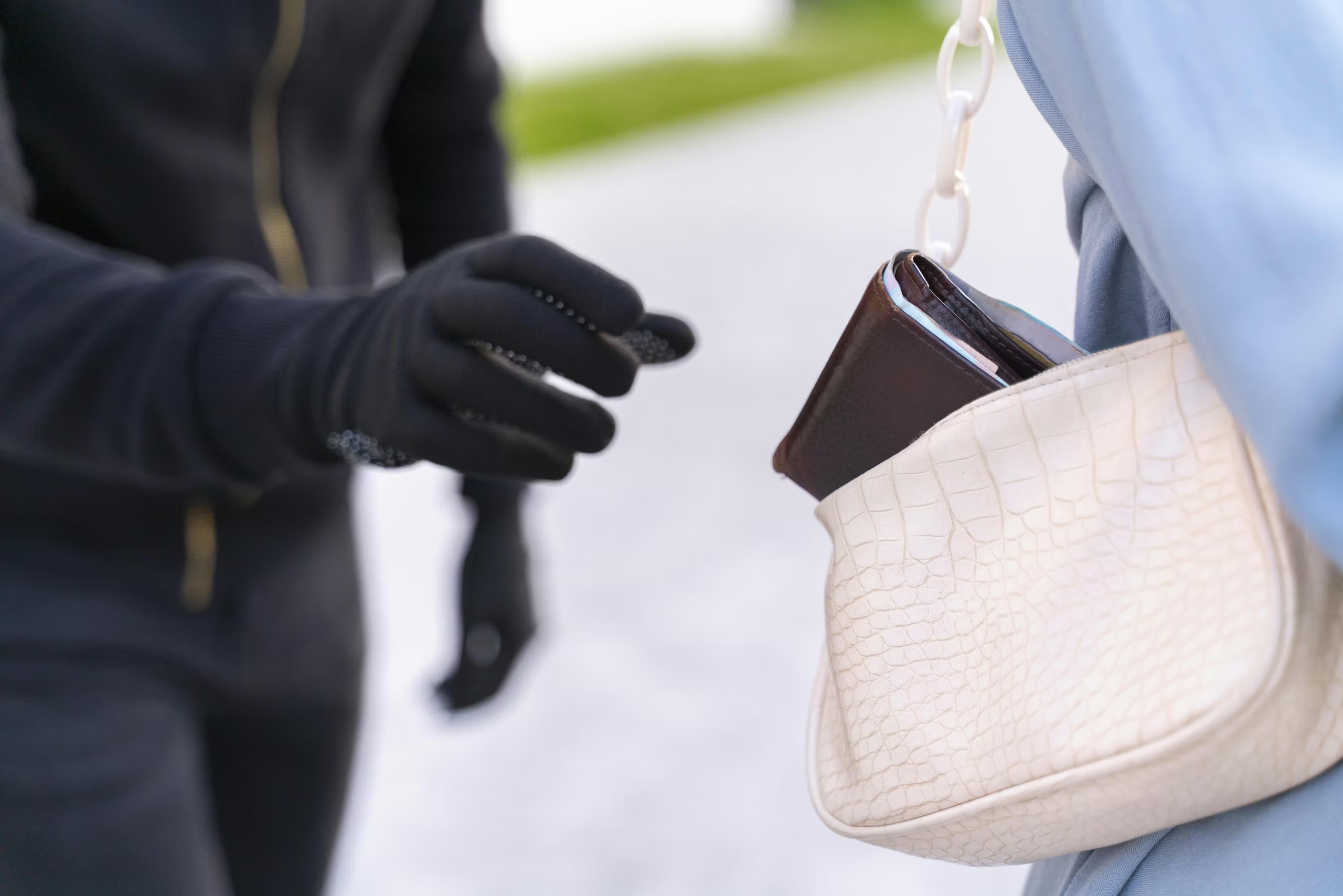
Urban safety is about density. Crowds, transit, pickpockets, scams, taxi friction, nightlife, and distraction. I watch hands in busy stations, avoid unofficial taxis, keep phones away from curb edges, and do not leave a bag on the back of a chair because the restaurant is nice. Nice restaurants have thieves too. Sometimes better dressed.
Rural safety feels softer and can be more dangerous. Quiet roads, long distances, patchy cell service, weather, animals, sharp bends, tired drivers, and delayed emergency response. Rural danger is not usually the dramatic stranger. It is the empty road after dark, the low fuel light, the wrong shoes, the turn taken too fast because the scenery made you lazy.
Road-safety research often points out that rural roads can account for a large share of fatalities despite fewer collisions. That tracks with experience. In the city, help is usually close. In the country, the problem has more time to become serious.
My rural rules are basic: fill up early, download maps, carry water, tell someone the route, do not over-drive after lunch, and respect weather. If a hotel says arrive before dark, I listen. If a guide says the road is not good after rain, I do not debate him because Google Maps looks cheerful. A lot of bad travel stories begin with “it was only another hour.”
This matters on luxury routes too. A polished lodge can still be three hours from serious medical care. A beautiful vineyard road can be unlit. A remote beach property can have one bridge out. The fact that the hotel has excellent linens does not mean the route has excellent infrastructure.
For road-heavy planning, I use the same discipline I wrote about in my road trip planning guide 2026: shorter driving days, earlier arrivals, and fewer heroic transitions. The safest itinerary is often the one with enough slack to make boring choices.
Female solo travel: the honest realities by region
Female solo travel gets written about in two lazy ways: fearless goddess or fragile victim. Neither is useful. The reality is more ordinary and more tiring. Most trips are not defined by danger. They are defined by low-grade friction: staring, comments, unsolicited help, unwanted conversation, men who interpret politeness as invitation, and the constant small calculation of how much attention you are receiving.
Recent solo female travel writing has cited a figure that 64% of women experience unwanted attention while traveling solo: catcalling, staring, inappropriate comments. That matches the mood more than the headline crime fear. It is not always violent. It is still draining.
Region matters, but not in a crude ranking way. Western Europe is generally manageable for experienced solo travelers, though nightlife, transit hubs, and crowded tourist zones still require attention. Japan, South Korea, Canada, Australia, New Zealand, and much of Northern Europe can feel structurally easier because transport and public order are strong. Some destinations require more planning around dress, transport, hotel location, harassment norms, and night movement. That does not mean “do not go.” It means do not arrive naïve.
Hotel choice matters more for solo women than travel articles admit. I want a central location, staffed reception, easy ride access, good lighting, secure elevators, and a restaurant or room service option if I do not want to go back out. A cheaper charming guesthouse down a dark lane may be fine with a partner and annoying alone. Luxury here is not marble. It is reduced exposure at tired hours.
I also use social camouflage. A wedding ring sometimes. Headphones without audio. Confident walking even when I am mildly lost. A “my husband is meeting me” line when I do not feel like debating reality. Is that annoying? Yes. Does it work often enough? Also yes.
For solo women, I recommend sharing location with one trusted person, using official taxis or vetted rides, avoiding first arrivals after midnight, and paying for safer logistics without guilt. If the choice is a $38 official transfer or a confusing transit experiment after a red-eye, I know what I am buying. Calm.
The point is not to shrink the trip. It is to remove unnecessary vulnerability so you can enjoy the trip. A solo dinner, a museum morning, a train ride, a beautiful hotel bar with a book — these are not consolation prizes. They are the good part.
Five Questions People Actually Ask
Does Level 2 mean I should avoid a country?
No. Level 2 means Exercise Increased Caution, and it includes many mainstream destinations such as France, Italy, Spain, the U.K., and Germany. Read the reason, then plan accordingly.
Is World Nomads the best travel insurance?
It can be a strong fit for adventure-heavy travelers, but not everyone. Compare World Nomads with IMG and Allianz based on medical limits, claims process, activity coverage, pre-existing conditions and evacuation needs.
Do I need medical evacuation coverage?
For remote, expedition, safari, ski, island, or small-ship trips, yes, I would seriously consider it. For a short city break in London or Paris, probably not as a separate membership unless your medical situation demands it.
Should I keep a passport photocopy in the hotel safe?
Keep a paper copy somewhere separate, but do not rely only on the safe. Use password-protected digital storage, one luggage copy, and carry the real passport only when required.
What is the safest thing to carry?
A working phone with data, offline documents, one backup card, a little cash, and good judgment. Not exciting. Effective.
Where to go next?
- Travel Insurance Comparison 2026 — the deeper breakdown of coverage, claims, evacuation, CFAR, and credit card limits.
- Road Trip Planning Guide 2026 — useful for understanding rural safety, driving fatigue, and route logistics.
- Luxury Travel 2026 — the broader framework for spending well, reducing friction, and planning trips that hold together.


